
5 Best Guns for Snakes – Ultimate Guide (2026)

What’s the right gun when a rattlesnake rears up three feet from your boot? Few scenarios demand a faster, smarter decision.
This guide compares five firearms built for short-range snake defense and field use. It’s aimed at landowners, ranch workers, and outdoorspeople who want practical, reliable options.
We break down the attributes that matter most: hit confidence at arm’s length, ease of carry, and ruggedness in the field. Each option is evaluated with real-world pros and cons, not marketing copy.
You’ll also get straight ammo guidance for short distances and tips on pattern testing from the actual gun you carry. And clear encounter protocols – how to avoid, retreat, and when to call trained help – are part of the plan.
By the end you’ll be able to match a compact defensive tool and the correct load to the most likely scenarios on your property. Safety and non-confrontation are the top priorities; shooting is a last resort.
You’ll also find a concise FAQ that cuts through myths about effectiveness and safety. Practical testing tips will help you verify patterns and penetration from your specific carry piece.
This isn’t about macho firepower. It’s about choosing the best tool for humane, effective, and safe handling of snake encounters.
Table of Contents
- Taurus Judge Snake Defense Revolver
- Taurus Raging Judge Heavy Duty Revolver
- Smith & Wesson Governor Multi Caliber Revolver
- Bond Arms Snake Slayer IV Derringer
- Colt Anaconda Hunting Revolver
- Choosing Ammo For Snake Defense
- What To Do During Snake Encounters
- What People Ask Most
- Conclusion For Best Guns For Snakes
1. Taurus Judge Snake Defense Revolver

Hogue OverMolded Rubber Monogrip for Taurus Tracker/Judge 73000
Ergonomic rubber grip improving control, recoil reduction, and secure handling for compact revolvers.
Rated the best overall for short‑range snake work, the Taurus Judge is a practical choice when you need confident hits at a few feet. It chambers both .410 shotshells and .45 Colt, so you can tailor power and pattern to the snake you’re facing.
The barrel options (2″–6.5″) let you balance concealability and pattern performance; longer barrels will generally tighten the pattern a bit, shorter barrels make it handier around the barn. Its shallow rifling is tuned to give moderate shot dispersion, which is exactly what you want at biting distances—enough spread to cover the small target, but not so wide that you miss entirely.
Frame choices—polymer, steel, or lightweight—mean you can prioritize carry comfort or durability depending on your use. The Judge is noted as durable for ranch and property pest control, so it stands up to rougher outdoor work without fuss.
In practice you’ll find the .410 pellet spread increases hit confidence at very close ranges and the ability to run .45 Colt gives you a fallback if you need more penetration. Expect moderate recoil with many .410 loads, which helps with follow‑ups compared with lighter derringers or pocket pistols, but be mindful that full‑power .410 can still kick noticeably.
Do test patterning from the exact gun you plan to carry—individual Judges can vary in pattern, so don’t rely on someone else’s results. If you want a durable, versatile short‑range tool for property and ranch work that’s optimized for snake‑shot performance, the Taurus Judge is hard to beat.
Pros
- Wide .410 pellet spread at close range
- Shoots .410 shotshells and .45 Colt seamlessly
- Moderate recoil with varied .410 loads
- Consistent pattern performance across sessions
Cons
- Pattern varies between individual guns—requires personal testing
- Heavier recoil with full‑power .410 on long sessions
2. Taurus Raging Judge Heavy Duty Revolver

5 Star 6RJ-454 Speedloader for Taurus 6-Shot Raging Judge .454/.45 LC
Rapid six-round loading device ensuring fast, reliable cylinder reloads for large-caliber revolvers.
The Taurus Raging Judge Heavy Duty Revolver is a purpose‑built, beefed‑up option for people who need extra power and durability in snake country. Built on a larger frame in the 2025 limited runs, it adds .454 Casull to the existing .45 Colt/.410 capability and comes with a six‑round capacity, so you’re not left reloading when a situation escalates.
Construction is stainless with cushioned/insert grips and a fiber‑optic front sight, which makes it a solid outdoor tool that resists weather and is quicker to acquire on a sudden target. The gun is known to tame heavy recoil from .454 or stout .410 loads, and testers note reliable patterning with 3″ .410 shells at short ranges — important when you must hit a small target like a snake’s head close in.
That said, it’s a heavy revolver by design. If you want something for all‑day carry around the ranch or on patrol, this model may feel bulky compared with lighter field pistols. Also be mindful that the added power raises the risk of overpenetration and can produce overly wide patterns on small snakes, so it’s best used where extra stopping power and corrosion resistance matter more than minimal weight.
Pros
- Tames heavy .454/.410 recoil
- Six‑round capacity
- Stainless build resists outdoor wear; reliable 3″ .410 patterns
- Fiber‑optic front sight for quick target acquisition
Cons
- Heavier than ideal for all‑day carry
- Excessive power can cause overpenetration or wide patterns on small snakes
3. Smith & Wesson Governor Multi Caliber Revolver

Belt Ride Ranch Series Leather Holster for S&W Governor
Premium leather carry holster offering comfortable belt ride, secure retention, and quick draw for medium-frame wheelguns.
I run the Smith & Wesson Governor when I want a single handgun that covers a lot of ground in the field. It accepts .410, .45 Colt, and .38 Special, which is the core reason I recommend it for snake work.
That multi‑caliber flexibility lets you match the load to the threat—fine shot or harder‑hitting rounds—without swapping guns. For mixed pest scenarios this is a huge practical advantage when you don’t know what you’ll encounter on a property check.
In use the Governor balances power and control, so you can deliver a humane dispatch at close range without fighting an overly heavy magnum. Its .410 patterns are reliable at biting ranges, which is where snake encounters typically happen.
One of the things I appreciate is the consistent performance across ammo types; you don’t get weird surprises when switching between .38 Special and .45 Colt or .410 shotshells. That predictability matters when you’re moving dogs or checking barns and need confidence in every shot.
It’s also comfortable for extended carry during barn/dog work—good for folks who patrol property all day. That said, it’s bulky for pocket carry, so it isn’t the best choice if you want a true conceal‑carry backup.
Remember the Governor isn’t a long‑range tool: shot dispersion widens faster than derringers past roughly 10 yards, so keep engagements close. If you want one versatile revolver for routine snake defense around a yard, barn, or vehicle, the Governor is mostly an excellent pick.
Pros
- Multi‑caliber flexibility for mixed pest scenarios.
- Reliable .410 patterns at biting ranges.
- Comfortable for extended carry (barn/dog work).
- Consistent performance across ammo types.
Cons
- Bulky for pocket carry vs compact alternatives.
- Shot dispersion widens faster than derringers past ~10 yards.
4. Bond Arms Snake Slayer IV Derringer

Replacement Premium XL Grips for Bond Arms Derringer
Oversized premium grips enhancing hand-fill, control, and recoil management for compact pocket pistols.
The Bond Arms Snake Slayer IV is an ultra‑compact derringer built specifically for arm’s‑length snake defense. It accepts .45 Colt and .410, which gives you a smooth, simple platform when you need a quick, decisive shot at very close range.
One standout feature is the option for longer barrels up to 4.65″, which improves pellet concentration in the kill zone. In practical terms that means using No. 6 shot from a 4.65″ barrel will give notably better pellet placement at snake‑biting distances.
Its stainless construction makes it durable for day‑to‑day carry around a barn or property, and the frame is small enough to stow as a backup without bulk. Functionally it runs clean — the outline notes reliable operation across varied .410 and .45 Colt loads with no jams reported, so you won’t be fighting malfunctions when time is short.
Expect a snappy recoil impulse because the frame is lightweight, but for most users that sharp snap is still controllable and lets you get off quick follow‑up shots if needed. Keep in mind its practical effective range is limited to roughly 5–7 yards, so this is a true close‑quarters tool rather than a reach‑out solution.
If you need a compact, straightforward backup for snake encounters at arm’s length, the Snake Slayer IV is a solid choice. It’s designed to put pellets where they count in the short distances that matter, while staying rugged and simple to operate.
Pros
- Excellent pellet placement at snake‑biting range (No. 6 shot)
- Reliable with .410 and .45 Colt — no jams reported
- Ultra‑compact, stowable backup; stainless construction
- Snappy but controllable recoil for quick shots
Cons
- Noticeably snappy recoil due to lightweight frame
- Practical effective range limited to roughly 5–7 yards
5. Colt Anaconda Hunting Revolver

DeSantis Wild Hog Hybrid OWB Revolver Holster compatible with Colt Anaconda 4
Hybrid outside-waistband holster combining leather and polymer for comfortable, secure ambidextrous carry of heavyweight 4-inch revolvers.
The Colt Anaconda is a .44 Magnum revolver that the outline says is favored by handgun hunters for a reason: it excels in accuracy and control. It was range‑tested at 20 yards with .44 loads and produced pinpoint accuracy and tight groups, so it’s clearly built for deliberate, precise shots rather than snap reactions.
Ergonomics are a strong point. The gun has good sights and a smooth DA/SA trigger that helps follow‑up shots stay on target. Combined with comfortable Hogue grips, the design reduces felt recoil and makes heavy magnum shooting more manageable during extended sessions.
The Anaconda’s heavy frame soaks up .44 Magnum recoil and cycles reliably, which matters if you plan to take more than one careful shot at a longer distance. That solidity and trigger quality make it an attractive choice if your snake encounters are likely to require accurate, controlled dispatching rather than a point‑blank blast.
On the flip side, the Anaconda is heavier and slower to draw than compact snake‑defense options. If you want a gun for arm’s‑length surprises or a pocketable backup, this isn’t ideal. Also, the exposed backstrap can irritate your hand after dozens of rounds, so prolonged high‑volume shooting sessions could become uncomfortable without mitigation.
Bottom line: pick the Anaconda if you prioritize accuracy, control, and recoil management for deliberate shots at slightly longer ranges. Skip it if you need a lightweight, fast‑to‑deploy snake gun for very close encounters.
Pros
- Pinpoint accuracy/tight groups at 20 yards with .44 loads
- Smooth DA/SA trigger and Hogue grips reduce felt recoil
- Heavy frame soaks up .44 Magnum recoil; reliable cycling
- Favored by handgun hunters for control and accuracy
Cons
- Exposed backstrap can irritate after dozens of rounds
- Heavier and slower to draw than compact snake‑defense options
Choosing Ammo For Snake Defense
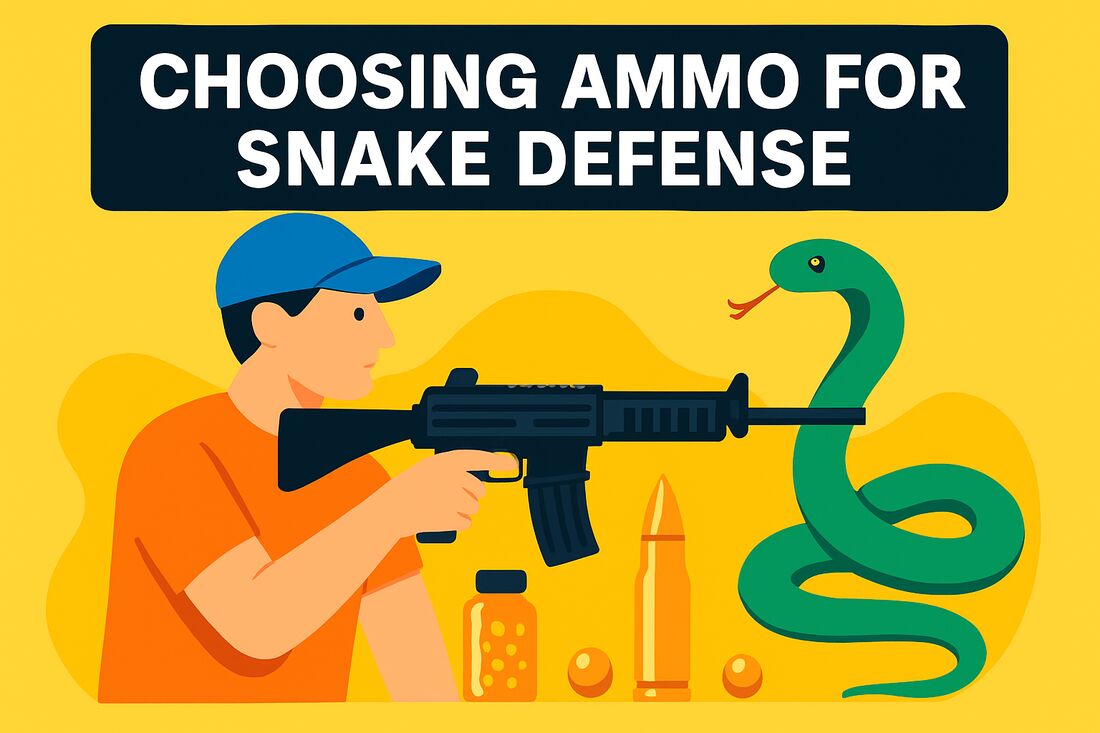
Choosing the right ammo often matters more than choosing the gun. Snake shot is designed to throw a dense cloud of small pellets that can incapacitate a snake’s head at close range while reducing the over‑penetration you get with full‑power bullets.
For the smallest snakes I reach for .22 LR shotshells with No.12–No.10; they’re light, low‑recoil and very effective at arm’s length. For most encounters .410 shells are the practical sweet spot — more pellets and energy from short revolver barrels or short shotguns. Pistol‑caliber snake loads exist, but their performance is inconsistent; only trust them after you pattern your specific pistol.
Shot size is the key tradeoff: finer shot gives denser patterns but much less penetration, while larger pellets penetrate deeper but leave bigger gaps in the pattern. Use No.12–#9 for tiny, very close snakes and move to #8–#4 for thick‑bodied or slightly longer engagements. Match the shot to the species you’re likely to meet and the distances you expect to engage.
Range and barrel type control everything — snake shot is a true short‑range tool and pellets lose energy fast. Expect useful results within a few yards; beyond that pattern cohesion and terminal effect fall off quickly. Barrel length, rifling and cylinder gaps will change spread, so always pattern the exact gun and load you carry at realistic distances.
A major advantage of snake shot is reduced over‑penetration, which matters around buildings, pets and livestock; its weakness is limited effect on large rattlers. Practical routine: buy purpose‑made snake/pest shotshells, test several brands and shot sizes on posterboard with a safe backstop, and keep notes so you can pick the smallest shot that reliably covers the head area at your expected range.
Above all, avoidance and habitat management beat any round. Use ammo wisely, practice safely, and call professionals for snakes inside buildings or when you’re unsure about species or risk.
What To Do During Snake Encounters
Seeing a snake can spike your adrenaline, but the best immediate move is simple: stay calm and give it space. Most snakes want to avoid you, and a clear escape route usually ends the encounter without anyone getting hurt.
Stop, remain quiet, and either freeze or back away slowly to a safe distance. Don’t make sudden moves or try to handle or kill it—those actions raise the risk of a bite, and even seemingly dead snakes can reflexively strike.
Put several feet between you and the animal and ensure it has a clear path in the direction it’s facing; do not corner it. If you can’t create an exit, reposition yourself so both you and the snake have room to retreat.
If it’s safe to do so, make a mental note of markings or take a distant photo to help with later identification. Never approach for a better look—if you’re unsure whether it’s venomous, assume it could be and stay put until help or advice is available.
Prevention is the real win: wear over‑the‑ankle boots or gaiters, long pants, and use a bright flashlight at night. Keep yards and work areas tidy, remove rodent attractants, and clear brush around buildings to reduce the chances of surprise encounters.
If a bite occurs, get emergency medical care immediately—antivenom is the only definitive treatment for venomous bites. While waiting, keep the victim calm and still, immobilize the bitten limb below heart level, remove rings or tight clothing, and monitor breathing and consciousness.
Do NOT apply a tourniquet, cut or suck the wound, or use ice—those measures do more harm than good. Also avoid trying to capture or kill the snake yourself unless you are trained; most preventable injuries happen during those attempts.
Call animal control or a trained snake handler if a snake is inside a building, threatens pets or livestock, or you can’t safely identify it. For properties with frequent encounters, establish a response plan, train staff, and keep simple PPE—gaiters and snake tongs or hooks—readily available.
What People Ask Most
What is the best gun for snakes?
There is no single best gun for all situations; choose a platform that matches your typical engagement distance and the species you encounter. Prioritize firearms that reliably pattern dedicated snake shot and that you can carry and operate comfortably in the field.
Is a .22 LR effective for killing snakes?
.22 LR shotshells with fine shot are commonly used and can be effective on very small snakes at very close range. Fine shot has limited penetration on thick‑bodied or larger venomous snakes, so it may not be adequate in those cases.
Are shotguns better than rifles for snakes?
Dedicated shotshells like .22 shotshells and .410 are often preferred for short‑range snake defense because they produce dense close‑range patterns and reduce over‑penetration compared with full‑power bullets. Their effectiveness is limited to very short distances, so pattern testing from your actual firearm is important.
What caliber is best for dispatching a snake humanely?
There is no single best caliber; match cartridge and shot size to the likely species and expected engagement distance. Use dedicated pest or snake shotshells and test patterns to ensure adequate placement and penetration for humane dispatch.
Can you safely shoot a snake on your property?
Using snake shot reduces the risk of over‑penetration and is generally safer near structures, livestock, and pets than full‑power bullets. If a snake is inside a building or you are unsure about identification, contact animal control or trained handlers instead of taking a shot.
Are air rifles or pellet guns effective against snakes?
Effectiveness of air rifles and pellet guns varies widely with power and the size of the snake, and many consumer airguns lack reliable penetration for larger venomous animals. They are generally not the primary recommended tool for snake defense, so rely on proven methods and professional help when unsure.
What type of ammunition should you use for shooting snakes?
Use dedicated snake shot loads appropriate to the target: fine‑shot .22 shotshells for very small, very close snakes and larger‑shot .410 loads for heavier or slightly more distant threats. Always test patterns from the actual firearm and match shot size to the species and engagement distance.
Conclusion For Best Guns For Snakes
Choosing the right tool is largely about role: opt for a short‑range platform for quick encounters, a heavier magnum‑capable option for larger threats, a multi‑caliber sidearm for flexibility, an ultra‑compact backup for arm’s‑length protection, or an accurate magnum revolver when precise longer shots may be needed.
Whatever you carry, test snake‑shot and other loads from the exact firearm you plan to use and match shot size to the species and typical engagement distance to maximize effectiveness while minimizing risk.
Prioritize non‑confrontation and safety: give snakes room to escape, use appropriate footwear and lighting in snake country, and contact trained handlers or animal control when a snake is inside buildings or its venomous status is unclear.
If you’d like to improve your decisions and field skills, read more of our practical guides and gear articles on the site to learn testing methods, ammunition considerations, and encounter protocols.
Have a question or a field tip to share? Leave a comment below — we usually reply within a few hours.