
5 Best Air Rifles for Target Shooting – Ultimate Guide (2026)

Which air rifle will shave tenths of an inch off your group and turn a steady hand into a podium finisher? Target shooting is a study in small margins. Every detail, from the trigger feel to shot-to-shot consistency, can move a group from decent to exceptional.
Finding the best air rifle for target shooting feels like navigating a maze of choices for users at every skill level. Some shooters chase ultra-precise regulation and shot repeatability, while others prioritize a natural, rifle-like feel and ergonomics. A rifle that tolerates different pellets and maintains steady velocities will usually out-group one that does not.
This guide distills hands-on range testing, chronograph data, and owner feedback into clear, practical recommendations. It focuses on real grouping performance and shootability rather than specs on paper. Expect readable analysis and straightforward advice aimed at helping you shoot tighter groups faster.
Whether you’re dialing in ten-meter paper precision or stretching pellets out on outdoor lanes, the right platform makes practice productive. Factors like trigger crispness, barrel harmonics, weight, and point-of-impact stability influence how repeatable your strings become. Good equipment reduces variables so you can improve through technique instead of fighting your kit.
I selected a compact set of rifles that proved themselves in accuracy, consistency, and user satisfaction. None are magic wands, but each earns its place when the target is the priority.
Table of Contents
1. FX Impact Air Rifle Review

Sig Sauer MCX Virtus PCP .22 Pellet Air Rifle
High-performance pre-charged pneumatic shooter delivering exceptional accuracy, low recoil, and rugged reliability for hunting or tactical training.
The FX Impact is one of the cleanest precision PCP platforms you can buy, chosen repeatedly in 2024–2025 expert roundups for accuracy, modularity and tuneability. As a shooter, I appreciate a rifle that arrives match‑grade and lets you shape it to the job.
Outdoor Life’s range testing put it at a 0.41″ average group at 45 yards and showed genuine 100‑yard capability, which tells you this rifle is not just marketing hype — it performs at long distances. In real use that match‑grade accuracy translates to tight, repeatable groups on paper and steel at competition ranges.
It’s ideal for benchrest, field target and long‑range pellet or slug work; competition shooters and precision hobbyists will find the platform purpose‑built. The modular design and multi‑calibre options let you configure the Impact for specific target classes without buying a whole new rifle.
User reports back this up: flawless sidelever and magazine cycling, an excellent out‑of‑the‑box trigger and a wide pellet tolerance that makes pellet testing less torturous. The rifle is tunable from hunting setups up to competition specs, and there’s strong aftermarket support for sights, regulators and stock options.
In regulated PCP configurations you’ll see high shot counts per fill and power that can be adjusted across calibres for consistent velocity strings. If you’re a serious target shooter or match competitor wanting a championship‑level, adaptable platform, the FX Impact is one of the best investments you can make — just be ready to learn the tuning side of it.
Pros
- Extremely high accuracy — 0.41″ avg at 45 yd; 100‑yard capability
- Highly modular / multi‑caliber configurability
- Excellent out‑of‑the‑box trigger and ergonomics
- Broad aftermarket and tuning support
Cons
- Complex to set up optimally for newcomers
- Some proprietary high‑pressure fittings and limited stock adjustability
2. Air Venturi Avenger Air Rifle Review

Gamo 6110017154 Varmint Air Rifle
Lightweight, accurate pest-control option with smooth action and adjustable sights for fast target acquisition in backyard or field.
The Air Venturi Avenger is a standout value pick for shooters who want PCP‑level consistency without a premium price. It was chosen for its balance of accuracy and regulated performance in the budget/midrange PCP category. Its regulated output and responsive sidelever make it an easy rifle to sling into club target sessions or backyard precision work.
In testing the Avenger posted a 45‑yard group average of ~0.44″ in the .25 test configuration, a very respectable result for its class. Chrono numbers were described as reliable, and the regulator adjustability is repeatedly praised for delivering repeatable velocities across strings. That combination is exactly what tight groups at typical target ranges needs.
The rifle’s ergonomics favor follow‑up accuracy: a rugged magazine and smooth sidelever let you cycle shots with minimal disruption to your position. The sizable reservoir plus regulator yields many accurate shots per fill when you set it sensibly, which is ideal for longer bench sessions or club practice without constant refills.
There are a couple of tradeoffs to know. Some users report the stock feels plasticky or hollow, so if a premium feel matters you may be disappointed. Also, to exploit the highest regulator settings you may need very high fill pressure, which could affect choices around your compressor or pump. Overall, the Avenger is a great fit for intermediate shooters who want regulated PCP performance and repeatable velocities without stepping up to flagship prices.
Pros
- Excellent accuracy/consistency for the price (~0.44″ at 45 yd in .25 test).
- Regulated output for repeatable velocities.
- Robust magazine and smooth sidelever for quick follow‑ups.
- High shot count per fill with sensible configuration.
Cons
- Stock feels plasticky/hollow to some users.
- High regulator settings may need very high fill pressure.
3. Air Arms S510 Tactical Air Rifle Review
Gamo 6110017154 Varmint Air Rifle
Affordable, easy-to-maintain plinking tool offering consistent pellet velocity and comfortable ergonomics for recreational shooting sessions.
The Air Arms S510 Tactical has a longstanding reputation for match‑grade accuracy paired with comfortable, rifle‑style ergonomics. It’s commonly praised for precision shooting and is also well suited to small‑game use.
Independent testing notes it as highly accurate, with smooth, fast cycling and consistently small group averages. That real‑world accuracy makes it an easy rifle to trust when dialing in for paper targets or precision plinking.
Its typical use is for precision plinking and target shooting, especially for shooters who prefer a natural rifle feel and AR‑style ergonomics. The S510 is also noted for quiet operation, which helps long practice sessions feel less fatiguing.
Owner feedback highlights the comfortable ergonomics and AR‑style grip/stock compatibility, as well as reliable pellet accuracy and overall quietness. The main caveats reported are a proprietary fill probe (included) and a trigger safety that can feel stiff out of the box.
Handling is one of the S510’s strengths: the fast, smooth sidelever action and pellet‑tolerant behavior make switching pellet types during a range session straightforward. That tolerance to different pellets is useful when you’re testing which load groups best for targets.
If you want a rifle‑like platform with consistent accuracy and modern ergonomics—or a dual‑purpose rifle for both target work and small game—the S510 is a very good fit. It’s particularly attractive to shooters who value shootability and a quiet, ergonomic package.
Pros
- User‑friendly ergonomics and AR‑style control compatibility
- Quiet, smooth operation reduces shooter fatigue
- Dependable pellet performance and real‑world accuracy
- Versatile for precision target shooting and small‑game practice
Cons
- Requires proprietary fill probe (included)
- Trigger safety can be stiff out of the box
4. Beeman R9 Air Rifle Review

Beeman PCP Underlever Air Rifle
Lever-cocked, air-reservoir design delivering smooth, consistent shots, excellent balance, and dependable accuracy for target practice and small-game hunting.
The Beeman R9 is one of the best spring‑piston rifles when PCP isn’t practical or allowed. It was chosen because it delivers shooter‑friendly characteristics and top springer accuracy without requiring compressors or tanks.
In Outdoor Life testing the R9 ranked as the best spring piston for smooth cycle and a Rekord‑style two‑stage trigger. The rifle produced an excellent 0.53″ average at 25 yards (four‑group average), which is impressive for a mechanical single‑powerplant design.
Use this rifle for field‑target clubs, backyard target practice, or anytime PCP refills are impractical. It’s a single‑shot, spring‑piston platform, so you don’t need fill gear — convenient for travel or ranges without compressors.
Owners report a crisp, two‑stage Rekord trigger and a surprisingly forgiving, less hold‑sensitive feel compared with many break barrels. Handling is notable for minimal vibration — the R9 is described as “twang‑free” with a predictable point‑of‑impact that helps you shoot tighter groups more consistently.
If you value an excellent factory trigger and out‑of‑the‑box accuracy in a springer, the R9 is an excellent choice. Keep in mind the trade‑offs: it requires more cocking effort than PCPs and follow‑up shots are slower because it’s single‑shot/low capacity — but for shooters who prioritize precision and simplicity, that’s a fair exchange.
Pros
- Smooth action and top Rekord trigger
- Less hold‑sensitive than many break barrels
- Excellent pellet accuracy at 25–30 yards
- No PCP fill equipment required
Cons
- Heavier cocking effort than PCPs
- Slower follow‑up and single‑shot/low capacity
5. RAW HM1000X Air Rifle Review
Gamo 6110017154 Varmint Air Rifle
Compact, user-friendly shooter with reliable feeding, durable build, and crisp trigger for improved grouping and seasonal pest control.
The RAW HM1000X is a premium US‑made precision PCP built around a factory match trigger and a stability‑focused weight. It’s aimed at competition shooters who want a purpose‑built platform for benchrest and match work.
Outdoor Life singled it out as an outstanding match‑trigger rifle with consistent accuracy and top build quality. That kind of endorsement matters when every point counts on the paper.
Typical uses are benchrest, precision target practice and match use where a stiff, accurate platform and a highly repeatable trigger are priorities. If you favour a rifle that stays steady through follow‑ups, the HM1000X was designed for that role.
Owner reports emphasize a heavy, well‑machined build and very good accuracy at match distances, with the trigger widely praised. Some shooters note they would prefer a wood stock for the feel, which is a personal preference rather than a performance issue.
Ergonomically it’s a robust, reliable platform that rewards settled shooting; the weight contributes to stability and consistent shot placement. Two common complaints are the rifle’s heaviness and the fact it doesn’t ship in a hard case by default.
That combination makes it ideal for match shooters and experienced target shooters who prioritise a purpose‑built US‑made PCP with a factory match trigger. If you travel frequently or need a lightweight off‑hand rifle, the HM1000X may not be the best choice without aftermarket solutions.
Expect match‑grade accuracy, a top‑tier trigger and solid machining — with the trade‑offs of mass and no included hard case. The rifle is available in multiple calibers to match target classes, and American manufacturing brings customer support that many owners value.
Pros
- Match‑grade accuracy and praised match trigger
- Solid, well‑machined build quality
- Available in multiple calibers
- American manufacturing and customer support
Cons
- Heavy — may be tiring for long standing or transport
- No hard case included by default
Choosing .177 Versus .22 Caliber
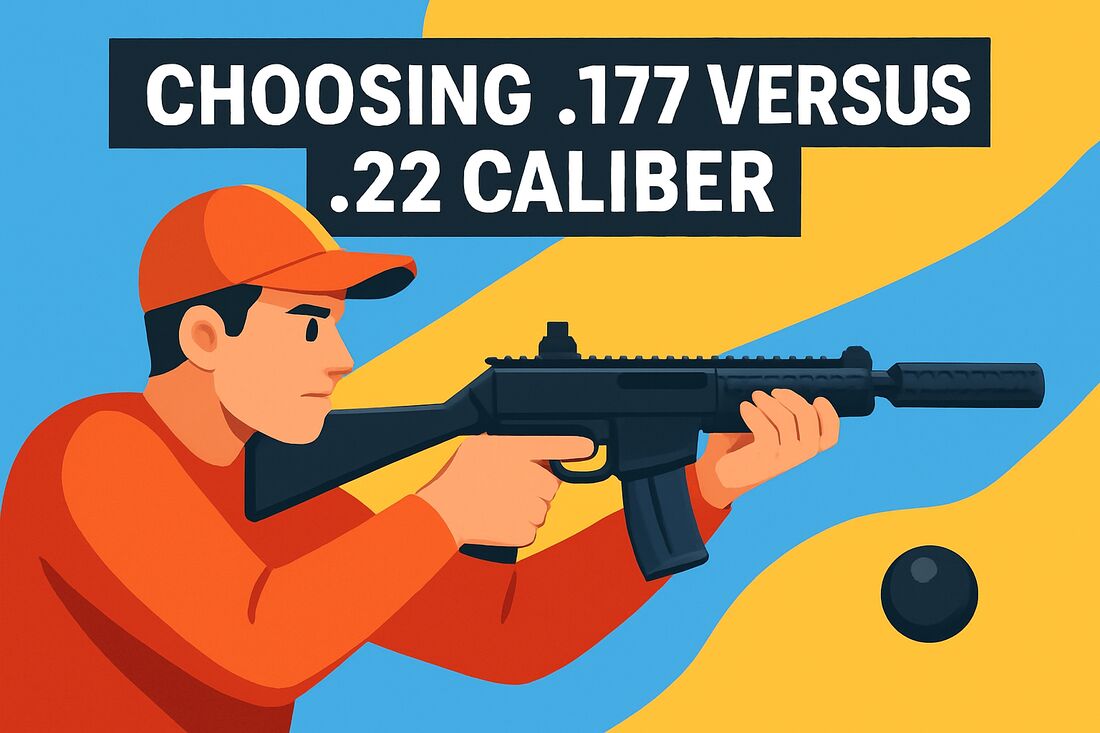
Picking between .177 and .22 comes down to simple physics and a bit of practicality. The .177 pellet is lighter, flies faster and gives a flatter trajectory; the .22 is heavier, carries more momentum and holds better in the wind. Those basic trade‑offs dictate most real‑world choices.
Competition norms reflect that. International 10‑m and most indoor paper disciplines use .177 because the flat flight and standard match pellets make centring easier. Field‑target and many outdoor events lean toward .22 for its superior retained energy on long shots.
That said, accuracy is rifle‑dependent, not religion. Barrel harmonics, twist rate and pellet shape matter as much as bore size; many rifles like 7–10‑grain domes in .177, while others group best with 14–18‑grain domes in .22. The only sure answer is to test your gun.
In practice I reach for .177 for short to mid‑range paper work where small holdovers and quick sight corrections help. I switch to .22 for 40‑meter-plus shooting or whenever wind is the story, because the heavier pellet stays on line and gives more consistent impacts at distance.
Don’t chase raw FPS. Pushing pellets toward the transonic region (~1,000–1,200 fps) often ruins accuracy; stable, subsonic flight tends to produce the tightest groups. Also remember legal energy and rifle design limit what combinations will actually perform well.
If you own a multi‑calibre platform, use it like a lab. Chronograph both setups, shoot reliable 10‑shot groups from a rest and log velocities and point‑of‑impact so you can see which calibre/pellet pair gives the best repeatability.
Watch POI shifts as much as group size; a small, consistent offset is manageable but wild shifts are a deal breaker. Re‑zero after any change and keep a simple range notebook with pellet type, weight, FPS and group averages for match prep.
My rule of thumb: 10–30 m and strict paper scoring → .177; 40 m+ and windy outdoor work → .22. Still, let your rifle’s groups decide. Carry both options if you can and be ready to switch based on conditions — flexibility wins more targets than dogma.
Choosing Pellets for Target Accuracy
Choosing the right pellet matters as much as the rifle and the shooter. A rifle will only show its true potential with pellets that match its power curve and barrel. Spend time on pellet selection and you will see tighter, more consistent groups.
Pellets come in a few useful shapes. Wadcutters cut neat holes in paper and are ideal for close‑range scoring. Domed pellets are the go‑to for consistency and longer ranges. Pointed and hollow points have niche uses but are less predictable for pure target work.
Weight changes everything. Lighter pellets fly faster and flatter but react more to wind. Heavier pellets carry more momentum and often group better in rifles tuned for mid or lower velocities. Match pellet weight to your rifle’s power and the conditions you shoot in.
Don’t chase raw velocity. Very high FPS risks transonic instability and poorer accuracy. PCPs and powerful springers are generally kinder to heavier domes, while low‑power guns may prefer lighter pellets to stabilize well.
Manufacturing consistency is critical. Buy proven lines from JSB, H&N, RWS or Crosman and visually inspect each tin for dents or wobble. Store pellets flat, dry and free of debris to avoid deformities that ruin groups.
Test like a match shooter. Use a solid benchrest, a chronograph if you have one and shoot 10‑shot groups with a wadcutter, two domes of different weights and a heavy pellet. Record group size, POI shift and any keyholing; the smallest, most repeatable group wins.
Practical rules: for indoor paper work try wadcutters if they group well in your rifle. For outdoor and windy ranges favour the heavier domed pellet your rifle stabilizes. Always re‑zero after changing pellet type—POI shifts are normal.
Avoid common mistakes: don’t use deformed or dirty pellets, don’t assume a popular pellet is best for your gun, and don’t switch pellets without testing. The reliable path to accuracy is simple: test, record, and pick the pellet that gives the smallest, most consistent 10‑shot groups.
What People Ask Most
What are the most accurate air rifles for target shooting?
The most accurate air rifles are those designed and tuned for precision, with stable power delivery and a crisp, repeatable trigger. Consistent manufacturing quality and a good match between rifle and pellet are key to top accuracy.
What caliber is best for air rifle target shooting?
Caliber choice depends on the range and conditions; .177 is commonly preferred for indoor and shorter‑range target work, while .22 is often chosen for outdoor and windier conditions. Accuracy ultimately depends on the rifle and pellet pairing rather than caliber alone.
How do I choose the best air rifle for target shooting?
Pick a rifle that suits your intended discipline, prioritizing a consistent powerplant, a predictable trigger, and comfortable ergonomics. Test rifles with different pellets and settle on the combination that produces the smallest, most consistent groups.
Are PCP air rifles better for target shooting than spring‑piston models?
PCP rifles often offer easier cocking, regulated power and higher shot counts per fill, which many target shooters prefer. Spring‑piston rifles can still be excellent for accuracy and are a simpler, self‑contained option where refilling PCPs is impractical.
What features should I look for in an air rifle for target shooting?
Look for a smooth, predictable trigger, a stable barrel and power delivery, and adjustable ergonomics such as stock and sights. Durability, consistent manufacturing tolerances and good aftermarket support also help with long‑term tuning and reliability.
How accurate are air rifles for target shooting at 50 yards?
Accuracy at 50 yards varies widely with the rifle, pellet choice and shooter skill, but purpose‑built precision air rifles can deliver tight, consistent groups at that distance. Regular testing and using pellets your rifle favors are essential to achieve the best results.
Are air rifles suitable for competitive target shooting?
Yes, air rifles are widely used in many competitive target disciplines and are a standard choice for match shooting. Choose a rifle that meets the rules of your discipline and focus on consistent tuning and practice to be competitive.
Conclusion for Best Target Air Rifles
Whether you’re chasing match‑grade groups or reliable backyard precision, the key takeaway is to match platform, caliber and pellet selection to the way you shoot rather than chasing one “best” rifle.
Consider ergonomics, trigger feel, and whether you need regulated consistency or the simplicity of a mechanical powerplant, then prioritize real‑world testing to confirm what performs best for you.
Spend time on ammunition testing with a stable rest and consistent conditions so you can pick the pellet and weight that produces the smallest, most repeatable groups in your rifle.
If you want to sharpen your skills and make smarter gear choices, explore more of our how‑to guides and reviews on the site to build the knowledge that leads to better accuracy and confidence on the range.
Have questions or want to share your own test results? Leave a comment below and we usually reply within a few hours to help you fine‑tune setup and pellet selection.