
5 Best Scopes for Air Rifles – Ultimate Guide (2026)
Which scope will turn an occasional hit into a consistent group under low light or across a cluttered field—especially when pellets and breezes conspire against you? Whether you hunt in thick cover at dawn, shoot field-target courses under time pressure, handle pest control in the yard, or just plink on weekends, the right optic can transform an air rifle’s performance. This guide compares five carefully chosen scopes across those real-world roles and shows what to prioritize for each mission.
Picking the best scope for an air rifle isn’t just about picking the highest magnification number on the box. Magnification influences target identification, field of view and stability; recoil durability decides whether the scope will hold zero on spring-piston or PCP rigs; parallax or adjustable objective matters for short-range correction; and reticle type plus optical clarity determine speed and confidence in low light. You’ll see how these elements trade off against weight, size and budget in practical shooting scenarios.
Expect clear, magazine-style guidance that skips hype and focuses on function. I’ll walk you through which features matter most for different rifles and uses, and what to test once the scope is mounted. Read on to match optics to your rifle and mission so your next shot behaves like you aimed it to.
Table of Contents
- Athlon Argos BTR Gen2 6-24×50 Scope
- Hawke Airmax 30 SF 8-32×50 Scope
- UTG 3-9×32 BugBuster AO Scope
- Hawke Vantage 3-9×40 AO IR Scope
- Hawke Sidewinder 30 FFP 4-16×50 Scope
- Choosing Scope Magnification For Air Rifles
- Zeroing Basics For Air Rifle Scopes
- What People Ask Most
- Conclusion For Best Scope For Air Rifle
1. Athlon Argos BTR Gen2 6-24×50 Scope

Athlon Optics Argos BTR GEN2 6-24×50 FFP Riflescope
High-performance first focal plane optic delivering exceptional long-range clarity, durable construction, and precise turrets for confident, repeatable shot placement.
Built for airgun enthusiasts who demand precision and durability, the Athlon Argos BTR Gen2 6-24×50 Scope covers a wide range of shooting scenarios from backyard plinking to field targets at midrange. It features 6–24x magnification with a 50mm objective and a first focal plane (FFP) reticle, so ranging and holdovers stay accurate at any zoom without rechecking. The glass clarity remains outstanding across varied lighting, delivering a bright, sharp image from dawn to dusk, while the smooth, responsive 6–24x zoom ring lets you dial in precision quickly.
Rugged construction is designed to withstand airgun recoil, including springers, so it won’t give up under heavy field use. For versatile users—hunters and competitors needing precision at multiple distances—this scope provides reliable performance from close to midrange, with the 6–24x range giving you flexibility in the field. The rugged build handles airgun recoil, including springers, so it holds zero through repeated shots. The First focal plane reticle contributes to accurate ranging at any zoom, making holdovers straightforward and consistent as you switch power.
Smooth zoom is a key advantage, enabling fast target acquisition without chasing parallax or hunting for the right power setting. While the high magnification excels at longer shots, keep in mind that high magnification can cause eye strain on close-range bright days, and the weight becomes noticeable on lighter rifles during long carries. Overall, it’s a solid choice for players who value precision, reliability, and field-ready toughness.
Pros
- Excellent low-light clarity for dawn/dusk hunts
- Precise, reliable turret tracking for competition-style shots
- Holds zero through repeated recoil cycles on PCP and spring-piston rifles
- Smooth zoom for fast target acquisition
Cons
- High magnification can cause eye strain on close-range bright days
- Noticeable weight on lighter rifles during long carries
2. Hawke Airmax 30 SF 8-32×50 Scope
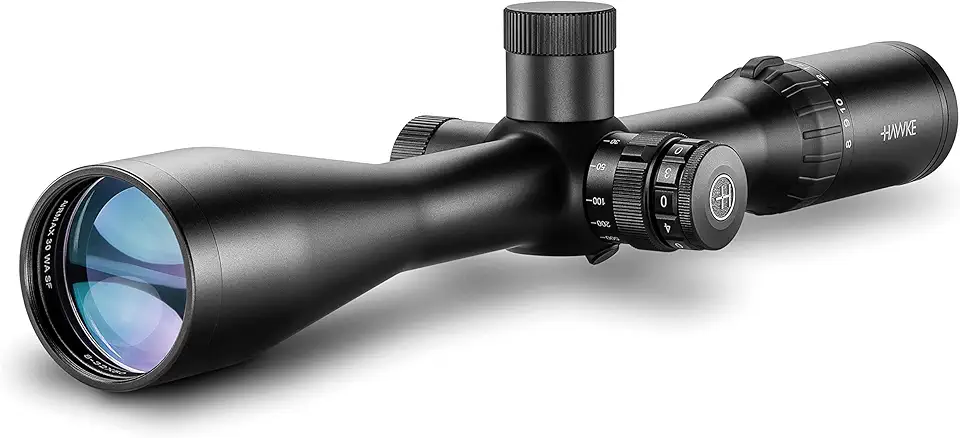
Hawke Airmax 30 SF 8-32×50 30mm Riflescope
Lightweight long-range optic with wide zoom, crisp glass, and low-profile mounts for steady, comfortable target acquisition.
Meet the Hawke Airmax 30 SF 8-32×50 Scope, a scope built for serious precision work with air rifles. It delivers 8-32x magnification behind a 50mm objective in a stout 30mm tube, with side-focus parallax and an etched glass reticle that can be illuminated. The rugged construction is tuned for dual-direction springer recoil, giving you confident performance on spring-powered rifles and PCP alike, while the glass and coatings stay resilient under field conditions.
The side-focus wheel is silky smooth and lets you lock in parallax quickly from 10 to 50 yards, which matters when you’re switching from close-range lanes to longer field targets. The etched reticle remains crisp and usable in low light thanks to illumination, helping you pull precise holds even as daylight fades. You’ll notice excellent zero retention after hundreds of shots on high-power airguns, so you won’t chase groups after every weekend session.
Where it truly shines is the optics, delivering sharp edge-to-edge clarity that reduces eye strain during long sessions. You’ll appreciate reliable illumination and crisp holdovers at distance, with consistent performance across benchrest or field targets. The trade-off is that 32x magnification can over-magnify close shots under ~20 yards, and the larger 30mm tube adds bulk for all-day carry.
Bottom line: for precision-focused shooters who want a robust, long-range capable scope, the Hawke Airmax 30 SF 8-32×50 is a strong choice for benchrest or field-target disciplines. It’s built to withstand springer recoil, keeps zero, and offers smooth parallax control from 10 to 50 yards. If you’re chasing tight groups and clear detail at distance, this scope is a solid partner.
Pros
- Smooth parallax wheel for quick focus at 10–50 yards
- Clear etched reticle and usable illumination in low light
- Excellent zero retention after hundreds of shots on high-power airguns
- Sharp, edge-to-edge optics reduce eye strain
Cons
- 32x over-magnifies close shots under ~20 yards
- Larger 30mm tube adds bulk for all-day carry
3. UTG 3-9×32 BugBuster AO Scope

UTG BugBuster 3-9×32 1
Compact, fogproof hunting optic offering bright lenses, quick-focus eyepiece, and rugged reliability for close-to-mid-range adventures.
UTG 3-9×32 BugBuster AO Scope is built for compact air rifles where size and resilience matter. It offers 3–9x magnification with a 32mm objective and an adjustable-objective (AO) for close-range parallax correction. Its compact, lightweight, shockproof design keeps it usable on entry-level rigs without adding unnecessary bulk, maintaining solid alignment through varied field conditions and recoil, even during extended hunts.
It’s practically indestructible and designed to survive heavy springer recoil while holding zero through persistent shooting. The AO sharpens the image at 10–30 yards, making pest control at close range quicker and more reliable. The build is rugged enough to withstand daily pest-control sessions and weekend plinking alike, and the coating resists scratches so visibility stays clear.
Its lightweight balance suits entry-level air rifles, so you don’t have to fight a front-heavy setup on pest-control tasks. The glass is clear with minimal color fringing at 9x, providing crisp target details across the entire zoom range and helping you spot pellets’ impact patterns without eye fatigue. That means quicker target reacquisition during fast-paced pesting, including urban yards.
In low-light conditions, the reticle can appear busy, slowing acquisition. The turrets can feel mushy after extended rough use. Its compact profile helps maintain a balanced feel during rapid target transitions.
Ideal for spring-piston owners and rugged, everyday pest-control use. This scope pairs well with entry-level rigs that prioritize balance and reliability over extreme magnification. If you value a true close-range AO capability in a rugged package, this is a solid budget option today.
Pros
- Practically indestructible; survives heavy springer recoil and holds zero
- AO sharpens image at 10–30 yards for pest control
- Lightweight balance on entry-level air rifles
- Clear glass with minimal color fringing at 9x
Cons
- Reticle can appear busy in low light, slowing acquisition
- Turrets feel mushy after extended rough use
4. Hawke Vantage 3-9×40 AO IR Scope

Hawke Vantage IR Riflescope
Versatile illuminated reticle optic with dependable glass, easy-to-adjust illumination, and robust build for dawn-to-dusk accuracy.
Take a close look at the Hawke Vantage 3-9×40 AO IR Scope. It offers 3–9x magnification and a 40mm objective, giving you a versatile field of view for air rifle use. With an Adjustable Objective (AO) and an illuminated reticle (IR), you can dial in parallax and improve visibility in low light, while the scope is designed for dual recoil of spring-piston rifles to maintain zero.
Illumination improves reticle visibility in dusk/wooded conditions, giving you a reliable aiming point when light fades. The scope delivers strong zero retention through springer recoil, so your holds stay true after multiple shots. Parallax adjustment is smooth, offering a 15–50 yard focus for versatile field use and bright optics with low distortion.
Built for practical hunting, this Hawke Vantage model fits hunters transitioning from rimfire and those using moderate-power air rifles in pest control. It pairs well with mid-range setups where reliability and quick target acquisition matter. The AO and IR features are designed to optimize performance across lighting and range conditions.
On the downside, the slightly heavier weight can fatigue arms on lightweight rifles. The illumination knob position can hinder quick access while shouldered. Despite these trade-offs, the Hawke Vantage offers solid performance for its intended roles.
Overall, the Hawke Vantage 3-9×40 AO IR offers versatile performance for hunters moving from rimfire to air rifles, combining parallax accuracy, illuminated targeting, and spring-piston recoil compatibility. If you value reliable zero, clear optics, and adaptable lighting in variable environments, this scope is worth considering. It remains a practical option for pesting and field use where parallax and reticle visibility matter.
Pros
- Illumination improves reticle visibility in dusk/wooded conditions
- Strong zero retention through springer recoil
- Smooth parallax adjustment for 15–50 yard focus
- Bright optics with low distortion
Cons
- Slightly heavier weight can fatigue arms on lightweight rifles
- Illumination knob position can hinder quick access while shouldered
5. Hawke Sidewinder 30 FFP 4-16×50 Scope

Vortex Razor HD Spotting Scope
Premium high-definition field optic delivering ultra-sharp, edge-to-edge detail, smooth focus, and rugged portability for glassing distant targets.
FFP reticle scales precisely for holdovers at any magnification, keeping aiming points consistent as you dial from low to high zoom. This helps hold accuracy across distances and zoom levels, a big win when you need reliable holds on the fly. That consistency across zoom levels helps you switch targets without re-zeroing.
Holds adjustments reliably on PCP rifles for consistent 50-yard groups. That reliability translates to steadier offhand shots and repeatable results at mid-range. That level of consistency also helps with muscle memory and rapid follow-up shots.
Fast parallax control makes bench work or offhand shooting snappy, letting you dial in distance quickly. This quick adjustment reduces time spent chasing focus and increases chances of a clean, repeatable shot. It also helps you lock onto distant targets with confidence.
Durable build resists fogging in humid conditions. The rugged construction helps maintain reliability in damp environments. It is designed for field use.
Ideal for intermediate shooters needing mid-to-long-range versatility for HFT and hunting. This scope balances performance across bench and field setups, making it a versatile choice for those who want to dial in longer-range shots without swapping optics. It’s a solid all-around option for versatile air rifle builds.
Pros
- FFP reticle scales precisely for holdovers at any magnification
- Holds adjustments reliably on PCP rifles for consistent 50-yard groups
- Fast parallax control for bench or offhand shooting
- Durable build resists fogging in humid conditions
Cons
- Bulkier profile can shift balance on smaller rifles (front-heavy)
- Higher magnification blurs edges slightly in very low light vs fixed-power scopes
Choosing Scope Magnification For Air Rifles
Choosing the right magnification for an air rifle scope isn’t just about chasing higher numbers. It’s about balance—how the scope handles recoil, where you’ll shoot most often, and how quickly you can acquire a target.
For close-range work, like backyard pesting or casual plinking, keep it simple with lower magnification. Look at 1–4x or 2–7x scopes; they cover roughly 30–100 yards and keep the field of view wide for fast snaps.
For general hunting and practice at mid-range, a mid-power setup shines. A 3–9x or 4–12x scope provides enough detail at 25–75 yards without weighing you down.
If you’re regularly shooting out to around 200 yards across varied terrain, 6–12x gives you usable holdovers. It also keeps you fast at closer ranges.
For long-range precision beyond 200 yards, 13–24x is the tool to lean on. It demands proper setup from rifle and pellet to exploit that level of detail.
Start with lower magnification to keep acquisition snappy; you can dial up as the distance increases. High magnification narrows the field of view and makes quick target tracking harder when you’re moving.
Use the exit pupil rule to size your setup. Objective diameter ÷ magnification should be around 7 mm for comfortable light transmission, especially in dawn or dusk hunts.
Airguns tend to pair better with mid-power variables because they balance image detail and recoil stability. The weight on your rifle stays manageable, too.
Match magnification to your rifle type. For CO2 or pump actions around 30 yards, 1.5–5x is a solid choice. For PCP or gas-ram platforms at mid-ranges, 4–12x gives you flexibility without overdoing it.
Avoid extreme magnification unless long-range precision is your main objective. Save the power for those rare long-range setups and keep a mid-range scope ready for everyday hunting and field target work.
Test your choice on your rifle and re-check at your typical distances. The right magnification should feel natural when you shoulder your rifle, not like you’re fighting the sight picture.
Zeroing Basics For Air Rifle Scopes
Zeroing a scope on an air rifle isn’t flashy, but it’s the core of reliable accuracy under field pressure. A solid zero keeps your shots true as distances shift.
Most air rifles settle best around 25–35 yards for a practical zero. This balances the arced trajectory of lightweight pellets with the ranges you’ll encounter in hunting and pest control.
Start from a stable rest and lock the mounts against forward and reverse recoil, especially with springers. A rock-solid setup prevents zero jumps.
Set magnification to your normal power, usually 6–9x. Higher power helps at distance, but it can make close shots harder to stack into a tight group.
Begin at 10–20 yards to center windage and elevation, then move to your target zero distance—around 30 yards for most rifles. This gradual approach keeps changes manageable and repeatable.
Fire three-shot groups and adjust in 1/4 MOA clicks. If the hits sit low, go up; if they drift left, nudge the reticle to the right.
Confirm your groups stay under about an inch at the zero distance. Recheck after roughly 50 rounds as the scope and pellets settle into a steady pattern.
Parallax matters. Use an AO scope set to the target distance; minimize parallax for reliable elevation control, starting near 10 yards.
Choose a mil-dot or duplex reticle for holdovers. Air rifles rarely zero flat beyond 40 yards; a typical .177 pellet drops about 2–3 inches at 40 yards, so plan your holds accordingly.
Test your zero in real conditions—wind and temperature matter. Re-zero seasonally and after scope changes or major rifle tweaks.
Done right, zeroing yields real gains: tighter groups, more hits on the first try, and better field consistency when you’re playing in varied terrain.
What People Ask Most
What is the best scope for an air rifle?
There isn’t a single best scope for every air rifle; the right choice depends on your rifle and how you plan to use it. Look for reliability, clear optics, and a reticle you can use comfortably. Also consider durability and mounting compatibility with your setup.
What magnification is best for an air rifle scope?
The best magnification depends on how you plan to shoot and the typical ranges you expect. Choose a level that offers a balance between field of view and detail for your intended use. Start with a moderate setting that fits a broad range of scenarios.
Are air rifle scopes different from regular rifle scopes?
Air rifle scopes share the same basic principles as regular scopes but are chosen to withstand the specific recoil and usage of air rifles. Look for scopes built for consistent zero retention and repeatable performance with airgun recoil. The core ideas remain clarity, reliability, and proper mounting.
What features should I look for in an air rifle scope?
Prioritize durability to handle recoil, clear optics, and a reliable reticle. Features like parallax adjustment or an adjustable objective, proper eye relief, and compatibility with your rifle can improve usability. Ensure the scope is suitable for your shooting style and environment.
What reticle is best for air rifle scopes?
Choose a reticle type that suits your shooting style and allows fast target acquisition. An etched or simple reticle can offer reliable visibility in varied lighting. The most important factor is selecting a reticle you can use confidently when aiming.
How do I choose the best scope for an air rifle?
Match the scope to your rifle and planned use, considering magnification range, durability, and image quality. Evaluate how the scope will feel on your rifle with mounting and balance in mind. If possible, test different options and ensure proper alignment and mounting.
What distance should I zero my air rifle scope?
Zeroing should reflect how you plan to shoot and the typical ranges you expect. Start at a practical distance that’s comfortable to shoot and confirm zero at a distance that fits your field use. Recheck zero periodically as gear or conditions change.
Conclusion For Best Scope For Air Rifle
Choosing the right air rifle scope comes down to matching magnification, recoil durability, parallax control, reticle design, and optics to your rifle and intended use.
Test your chosen scope on your rifle and re-zero before field use to ensure reliable performance across conditions.
To keep improving, browse more articles on our site for practical tips, drills, and gear considerations that fit your style.
Have thoughts or experiences to share? Leave a comment below — we usually reply within a few hours.