
5 Best PCP Compressors for The Money – Complete Guide (2026)
Ever stood in the field with an empty PCP and wished you could swap in a reliable, quiet, and wallet‑friendly compressor without second‑guessing the choice? This is a money‑smart, hands‑on guide to the top five PCP compressors for 2025, focused on real users and real budgets. We cut past marketing copy to give practical, experience‑driven advice you can use the same day, so you can get back to shooting and not troubleshooting.
You’ll learn which compressors are best for specific use cases — from fast rifle fills at the range to compact gear for vehicle and field work and multi‑shooter events where speed matters. We explain the tradeoffs between cooling methods and duty cycles and how those affect runtime, maintenance, safety, and overall life expectancy. Finally, we walk through the long‑term cost drivers that matter most to owners: consumables, service intervals, and parts availability.
Our hands‑on testing looked at real fill speeds, heat buildup under repeat cycles, neighborhood and workshop noise, and evaluate portability tradeoffs for hunters and club shooters alike. No fluff, no spec‑sheet obsession — just clear comparisons that match gear strengths to your routine and budget. Keep reading to find the best PCP compressor for the money and make a confident buy that lasts.
Table of Contents
- Air Venturi NOMAD III PCP Compressor Overview
- GX PUMP CS3 PCP Compressor Overview
- AirVenturi ROVAIR 4500 Portable Compressor Overview
- Hatsan TactAir Spark PCP Compressor Overview
- JTS COMP1 Portable PCP Compressor Overview
- Cooling Systems To Consider
- Budgeting For Long Term Costs
- What People Ask Most
- Conclusion For Best PCP Compressor Value
1. Air Venturi NOMAD III PCP Compressor Overview

Air Venturi Nomad III 4500 PSI PCP Compressor
Lightweight portable high-pressure fill unit delivers fast, quiet fills with efficient cooling and intuitive controls for range or field use.
Air Venturi NOMAD III PCP Compressor stands out as the most versatile option in hands-on testing, capable of handling everything from portable pistols to full-sized tanks, a rare blend of portability and power. This flexibility makes it ideal for shooters who move between field fills and bench setups, adapting to tight spots and larger work areas without swapping gear. It deploys quickly for on-site fills and maintains steady operation across multiple cycles, so you stay in the action without babysitting the unit.
Power-source flexibility is a standout feature, as it seamlessly switches power sources for uninterrupted field fills, a real safeguard when you’re off-grid. The unit also offers user-friendly controls that cut setup time, letting you dial in pressures and start fills without fiddling. It handles diverse rifle volumes—from pistols to larger tanks—and the low vibration keeps the rig stable on uneven surfaces during busy sessions.
That said, there are tradeoffs to consider when you commit to the NOMAD III for field use. You’ll notice heat buildup after prolonged use, so plan for deliberate pauses to prevent overheating during long sessions. And the NOMAD III comes in a bulkier frame that isn’t ideal for ultralight backpacking, which can affect mobility in rugged terrain.
Versatility isn’t just a buzzword here; it covers field fills for pistol-sized rigs and larger tanks. The NOMAD III deploys quickly for on-site fills and keeps its performance steady across multiple cycles. This combination supports reliable field operation for a range of setups, from quick field top-offs to extended testing and practice.
Pros
- Seamlessly switches power sources for uninterrupted field fills.
- User-friendly controls reduce setup time.
- Handles diverse rifle volumes (pistols to larger tanks).
- Low vibration keeps unit stable on uneven surfaces.
Cons
- Noticeable heat buildup after prolonged use; requires pauses.
- Bulkier frame not ideal for ultralight backpacking.
2. GX PUMP CS3 PCP Compressor Overview

GX PUMP GX-E-CS3 4500 PSI PCP Compressor 12V/110V
Dual-voltage fill solution for on-the-go or workshop use; fast, reliable pressurization, built-in safety features and easy setup.
GX PUMP CS3 PCP Compressor Overview is frequently recommended as a top, reliable choice for everyday PCP filling, built to withstand the rigors of regular use in busy home garages or on the range between matches. It’s designed to be durable for garage or range sessions, giving you confidence that you won’t stall mid-fill during a weekend skirmish when you need to top off multiple guns before a field day. If you’re an airsoft player who refills on the regular, this unit delivers steady performance without adding unnecessary hassle, keeping your squad in action instead of waiting on equipment.
One standout feature is the auto shut-off that prevents overfilling, letting you walk away without worrying about over-pressurized tanks or the risk of a sudden push past your target. It maintains a steady speed for back-to-back fills, so you can cycle through multiple tanks with minimal downtime, which is exactly what you need during long practice days or crowded events. Compact enough for countertop or workshop use, it fits neatly on a bench or in a garage corner, and it also performs well for multiple users in group events, sharing the same unit without chaos.
Be aware of the trade-offs: the fans can be loud out of the box, so many users run it in a garage to keep noise away from teammates. It also gets hot during extended bottle fills and may need cooling breaks to maintain performance, especially on back-to-back fills with larger tanks. Despite that, the core reliability and compact design make it a solid choice for regular PCP fills.
Pros
- Auto shut-off prevents overfilling.
- Maintains steady speed for back-to-back fills.
- Compact enough for countertop/workshop use.
- Performs well for multiple users in group events.
Cons
- Fans loud out of the box; often used in a garage.
- Gets hot during extended bottle fills; needs cooling breaks.
3. AirVenturi ROVAIR 4500 Portable Compressor Overview

Air Venturi RovAir 4500 PCP Compressor
Compact, low-vibration high-pressure unit offering automatic shutoff, efficient cooling, and dependable performance for quick cylinder refills anywhere.
AirVenturi ROVAIR 4500 Portable Compressor PCP Compressor is recognized as the best value for direct rifle fills; quiet, fast, and power-source flexible, it blends portable convenience with true fill performance. The quick take frames it as the best value for direct rifle fills with quiet operation, fast fills, and power-source flexibility. In practical terms, that means you’re getting a field-ready unit that won’t break the bank.
Very quick and quiet rifle fills let you swap rifles or top off tanks in moments, so downtime stays minimal, and you can stay in the action without fuss. Compared with bulkier rigs, it keeps a compact profile without sacrificing speed, which means easier transport and quicker setup at the line. That combination makes it a solid choice for backyard ranges or field hunts where silence matters and reliability wins rounds.
It accepts multiple power sources (e.g., car batteries), giving real flexibility whether you’re on the road or at the range, which helps when access to shop power is limited. The interface is simple for beginner-friendly fills, so you can rack up consistent performance without a steep learning curve, even when you’re in a hurry. If you’re after minimal upkeep, this model stands out by reducing maintenance between sessions.
Direct-fill performance remains stable for rapid rifle swaps, letting you move from one fill to the next without hiccups, even during back-to-back cycles. Although it keeps fills smooth, a short fill hose limits reach and you’ll need to reposition during fills. There’s no carrying case included, so transport can lead to minor dings.
Pros
- Very quick and quiet rifle fills.
- Accepts multiple power sources (e.g., car batteries).
- Simple interface for beginner-friendly fills.
- Stable direct-fill performance for rapid rifle swaps.
Cons
- Short fill hose limits reach; requires repositioning.
- No carrying case included; transport can lead to minor dings.
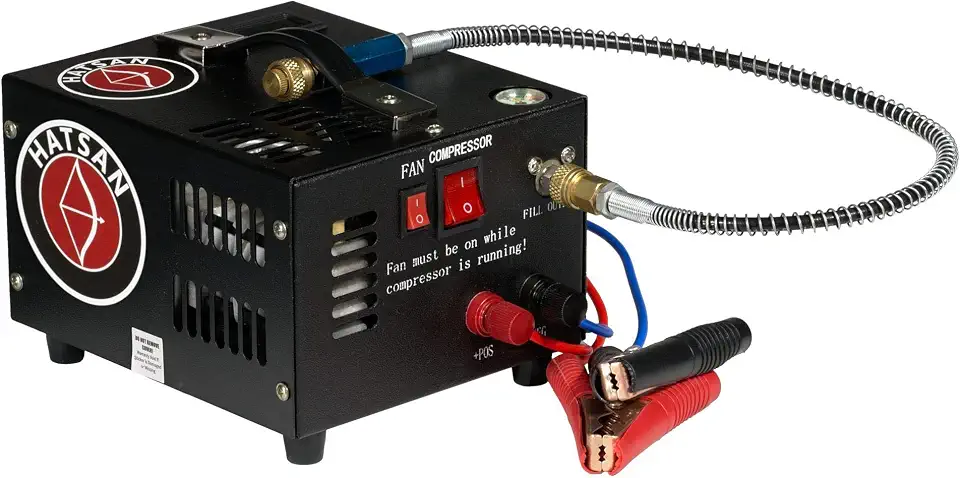
4. Hatsan TactAir Spark PCP Compressor Overview
Hatsan TactAir Spark PCP Compressor
Rugged, fast-filling system designed for durability and consistent pressure; simple controls, fast warm-up, ideal for demanding shooting sessions.
The Hatsan TactAir Spark PCP Compressor is cited as the most compact PCP compressor, shoebox-sized for tight storage and vehicle use. That form factor helps keep your setup lean when space is at a premium. It nails the portability game without sacrificing the ability to fill PCP tanks on the road.
Extremely small footprint for instant deployment. This design lets you get to work quickly when you’ve just landed at a range or in the field. That instant deployment edge helps you adapt to dynamic field conditions.
Straightforward controls for quick starts. You won’t spend ages fiddling with settings before a fill. The straightforward interface helps you focus on loading and shooting rather than tweaking the machine.
Lightweight and easy to carry. Packs away neatly. That combination makes it a natural choice for mobile hunter setups.
Reliable for short bursts (pistol/small rifle fills). In practice, you can top off quickly between matches. The unit’s reliability shines when you need to keep moving between targets.
Cons: High noise and vibration during operation. Cons: Slowest fill times; longer waits for larger rifles in groups.
If portability is your top priority, this Hatsan is a strong option. For those who need rapid, frequent fills of larger rifles, the drawbacks are more noticeable.
Pros
- Extremely small footprint for instant deployment.
- Straightforward controls for quick starts.
- Lightweight and easy to carry.
- Reliable for short bursts (pistol/small rifle fills).
Cons
- High noise and vibration during operation.
- Slowest fill times; longer waits for larger rifles in groups.
5. JTS COMP1 Portable PCP Compressor Overview

JTS COMP1 PCP Compressor
Compact, user-friendly compressor for reliable fills, energy-efficient motor, low noise, perfect for home range and field use.
JTS COMP1 Portable PCP Compressor is widely recognized as the quietest option in this guide, a distinction that matters when your practice space is near sleeping areas. Lauded for its quiet operation, it’s ideal for home or neighborhood use without noise complaints. It’s quiet enough for garage use without ear protection, letting you run fills without waking the household.
Performance-wise, you get strong, consistent fills that stay steady across a long sequence of fills, all while remaining compact. That means you can count on it for regular home sessions, day after day. It has a solid, durable build for daily use, and the design is friendly for repeated fills, making it a dependable workhorse on the bench.
User experience is straightforward, with user-friendly handling for repeated daily fills. The system is built to stay reliable through regular practice sessions, so you can focus on aim and timing rather than fiddling with hardware. That simplicity translates into confident operation during long sessions.
Portability is a real plus, offering good portability while delivering benchtop reliability. You can move it around the shop or set it up on a compact bench without sacrificing stability. The compact design also makes storage easy when you’re not in the middle of a fill.
On the flip side, this unit requires a separate AC power module, which can be less convenient for field work. It also lacks a quick-release hose, which slows swaps between rifles and tanks. That combination means more planning if you’re taking it on the road, and swapping between gear takes longer.
Pros
- Quiet enough for garage use without ear protection.
- Strong, consistent fills comparable to larger units.
- Solid build for regular home sessions.
- User-friendly for repeated daily fills.
- Good portability while offering benchtop reliability.
Cons
- Requires a separate AC power module (less convenient for field).
- No quick-release hose; slows swaps between rifles/tanks.
Cooling Systems To Consider
Cooling systems aren’t the flashiest part of a PCP compressor, but they’re what let you actually run long, steady fills without overheating the unit or compromising the air you’re delivering. In the field, heat is real, and heat fatigue is real.
When you’re choosing, think about how you’ll use the unit. Portables rely on air cooling with fans, and big airflow helps. But if you’re grinding out back‑to‑back fills, you’ll want more aggressive cooling or a water‑cooled loop to keep temperatures in check.
Water cooling removes heat far more efficiently than air alone. A self‑contained water loop or a hybrid system can push longer run times with lower peak temps on the final stage, which means fewer breaks and more consistent fills. Just keep in mind water systems add complexity and require a pump, reservoir, and ongoing maintenance.
Intercoolers in multi‑stage designs cut heat between stages and help remove moisture from the air path. This protection matters for filtration performance and longevity of seals and valves. If you refill at a range, an intercooler is a smart upgrade.
When you study specs, look for mentions of intercoolers, intercooler piping, oil/water separators, and the stated continuous run time or duty cycle. Automatic protections—thermal cutouts and automatic stop at target pressure—are lifesavers for beginners and busy days. A unit that lists a sensible duty cycle is less likely to throttle in the middle of a session.
Practical checks during a test run are easy. Note how quickly the unit warms up and how long cool‑down takes. Listen for fan operation and confirm whether water cooling requires external circulation or is a self‑contained loop.
In the end, match cooling to your routine. If portability is non‑negotiable, you’ll accept a lighter unit with simpler cooling and shorter continuous pulls. If you run big fills at the range or in a workshop, a well‑engineered cooling system pays for itself in reliability and fewer downtime moments.
Budgeting For Long Term Costs
When you’re buying a PCP compressor, the sticker price matters, but it isn’t the whole story. The long-term costs come from reliability, service intervals, and the ongoing bill for filters, separators, and carbon cartridges. In the field and on the bench, downtime costs more than the upfront savings, so plan for a year or two of use.
Start by matching capacity and duty cycle to your routine. If you’re constantly filling multiple rifles or large tanks at events, opt for a higher-capacity, multi-stage unit with solid intercooling and a generous duty cycle. For casual, occasional fills, a compact, fan‑cooled model can save money now and stay cooler in a home shop.
Don’t overlook recurring consumables that quietly drive up annual costs. Budget for filters, oil/water separators, molecular sieves, and carbon cartridges, and check replacement intervals in the manual. Those little items wear out with every fill and can outpace the price gap between rival models over the long run.
Prioritize designs that are serviceable and rely on common parts. Clear manuals and local support keep downtime to a minimum and repair bills reasonable. A unit with readily available spare parts is a safer bet for a player who depends on consistency.
Cooling and duty specs aren’t flashy, but they’re the difference-maker for longevity. Intercoolers, automatic protections, and robust cooling reduce heat buildup and moisture, extending component life and reducing replacement cycles. Read the spec sheet for continuous run times and whether the unit uses automatic stop at set pressures.
If portability is non‑negotiable, expect tradeoffs in cooling and continuous run times. Lighter units are easy to move, but may require more frequent maintenance and shorter fills between cooldowns. Factor those compromises into your budget, and plan for occasional field spares or extra batteries.
What People Ask Most
How does a PCP compressor work?
A PCP compressor draws in ambient air and compresses it into a storage tank for later use. The stored air is then delivered to a PCP airgun to reach the needed fill pressure. Safety features and clear user guidelines help keep operation safe and reliable.
Can I fill a PCP airgun at home?
Yes, you can fill a PCP airgun at home using a compressor. Always follow the manufacturer’s guidelines and practice proper safety. Ensure your setup is appropriate for repeated fills and in a suitable space.
What features should I look for in a PCP compressor?
Look for reliable operation and ease of use, such as auto shut-off and a steady fill rate. A compact design, multiple power sources, and a simple interface are helpful for home or field use. Also consider automatic protections like thermal cutouts or auto stop at a set pressure to protect equipment and users.
Are PCP compressors loud?
Some models can be noticeably loud, while others are designed for quieter operation. Size, design, and mounting location influence noise in real-world use. Consider your environment when choosing a unit.
Do PCP compressors require oil lubrication?
Many PCP compressors have lubrication requirements that should be followed according to the model. Refer to the manual for guidance on oil use and maintenance. Proper lubrication helps maintain performance and safety.
How long does it take to fill a PCP tank with a compressor?
Fill times vary depending on the unit and tank size. Follow the manufacturer guidelines and monitor the fill process to ensure safe operation. Real-world timing depends on the equipment and use case.
Can a standard air compressor be used to fill PCP tanks?
Not all standard air compressors are suitable for PCP fills. A dedicated PCP compressor or a setup designed for PCP filling is typically recommended. Always follow the device instructions and safety guidelines.
Conclusion For Best PCP Compressor Value
The key tradeoffs boil down to cooling performance and duty cycle, portability, noise, and long‑term ownership costs. By aligning these factors with how you actually use a PCP compressor—whether in the field, at home or in a garage, or for frequent large‑tank fills—you can choose the model that best fits your routine.
Match a compressor’s strengths to your normal routine and budget, balancing field use, home/garage fills, and the need for larger or more frequent tank fills. For ongoing skill improvement, read more articles on our site to sharpen your PCP filling knowledge.
Leave a comment below; we usually reply within a few hours. Now compare the five picks against your primary use case.