
Airsoft FPS vs Joules
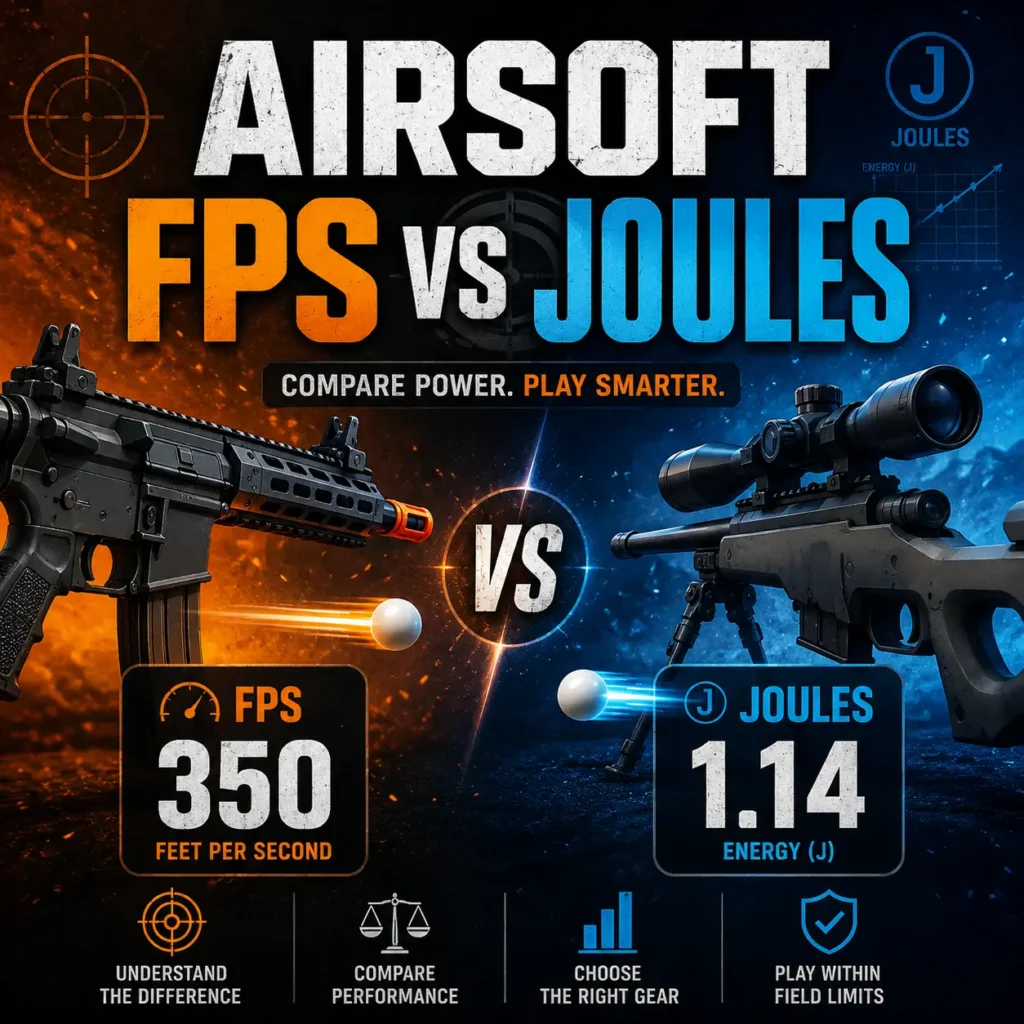
Airsoft FPS vs joules is one of the most important concepts every airsoft player should understand. FPS measures how fast a BB travels, while joules measure how much energy the BB carries. Because joules account for both velocity and BB weight, they provide a more accurate representation of an airsoft gun’s actual power.
Airsoft FPS vs Joules: What Do They Mean?
Many players use the terms FPS and joules interchangeably, but they measure completely different things.
FPS (Feet Per Second) measures the speed of the BB as it leaves the barrel. If a rifle shoots at 400 FPS, the BB travels 400 feet every second immediately after firing.
Joules (J) measure kinetic energy. This tells you how much force the BB carries when it leaves the barrel.
While FPS is easy to understand, it only tells part of the story because it ignores BB weight. Joules provide a more complete picture because they account for both mass and velocity.
Why FPS Alone Can Be Misleading
For many years, airsoft fields relied almost exclusively on FPS limits. Players would chrono using 0.20g BBs, and if the gun remained under the site’s FPS limit, it was considered legal.
The problem is that two guns can produce the same FPS while delivering different amounts of energy.
Consider the following example:
| Gun | BB Weight | Velocity | Energy |
|---|---|---|---|
| Rifle A | 0.20g | 400 FPS | 1.49 J |
| Rifle B | 0.30g | 400 FPS | 2.23 J |
Both rifles display the same FPS, but Rifle B produces significantly more energy.
This demonstrates why velocity alone cannot accurately represent actual power.
How Joules Are Calculated
Muzzle energy is calculated using the kinetic energy formula:
Energy (J) = 0.5 × mass (kg) × velocity² (m/s)
To use this formula correctly, BB weight must be converted to kilograms and velocity must be measured in meters per second.
If your chronograph displays FPS, you can convert it using:
m/s = FPS × 0.3048
Because velocity is squared in the formula, even small increases in speed can significantly increase muzzle energy.
You can quickly calculate energy using our FPS to joule calculator.
How to Convert FPS to Joules
One of the most common questions players ask is how to convert FPS to joules.
The answer depends on BB weight.
A velocity reading without BB weight is incomplete because the same FPS can produce different energy values depending on the ammunition used.
Here are some common examples:
| BB Weight | FPS | Joules |
|---|---|---|
| 0.20g | 300 FPS | 0.84 J |
| 0.20g | 350 FPS | 1.14 J |
| 0.20g | 400 FPS | 1.49 J |
| 0.20g | 450 FPS | 1.88 J |
| 0.20g | 500 FPS | 2.32 J |
If you switch to a heavier BB, the resulting joule value changes even if FPS remains similar.
FPS vs Joules Airsoft: Which Measurement Is Better?
When discussing fps vs joules airsoft, neither measurement is completely useless. They simply serve different purposes.
FPS is useful because:
- It is easy to measure.
- Most chronographs display it by default.
- Players quickly understand velocity differences.
- It helps identify consistency issues.
Joules are useful because:
- They account for BB weight.
- They measure actual muzzle energy.
- They improve safety enforcement.
- They detect power differences hidden by FPS readings.
- They help identify joule creep.
For safety and field compliance, joules are generally considered the more accurate measurement.
Is FPS or Joules More Important?
A common question is is FPS or joules more important.
If the goal is measuring actual power, joules are more important.
FPS only describes speed, while joules describe energy. A BB traveling slightly slower may still deliver more energy if it is significantly heavier.
This is why more airsoft fields are moving toward joule-based chrono rules.
That said, FPS remains useful for understanding trajectory, hop-up tuning, and consistency.
The best approach is to understand both measurements rather than relying exclusively on one.
Why BB Weight Changes Everything
BB weight plays a major role when comparing FPS and joules.
As BB weight increases:
- FPS usually decreases.
- Momentum increases.
- Wind resistance improves.
- Energy retention often improves.
This is why many experienced players prefer heavier BBs despite lower chronograph readings.
The ideal BB weight depends on the platform and intended use.
For a complete breakdown, see our airsoft BB weight guide.
How Joule Creep Affects FPS Readings
One reason FPS-based limits can be problematic is a phenomenon known as joule creep.
Joule creep occurs when heavier BBs produce more muzzle energy than expected. This effect is commonly observed in certain HPA setups, DMRs, and sniper rifles.
A rifle may appear legal when tested with 0.20g BBs but exceed energy limits when firing heavier ammunition during gameplay.
This is one reason many sites now chrono players using their actual game BB weight.
To learn more, see what is joule creep.
Why More Airsoft Fields Use Joule Limits
Over the last decade, many airsoft organizations have transitioned toward joule-based regulations.
The advantages include:
- More accurate power measurement.
- Improved player safety.
- Reduced exploitation of BB weight differences.
- Better management of HPA systems.
- More consistent field enforcement.
Rather than relying solely on FPS numbers, field staff can evaluate the actual energy being delivered by the projectile.
Typical FPS and Joule Limits by Platform
| Platform | Typical FPS Limit (0.20g) | Typical Joule Limit |
|---|---|---|
| CQB Rifle | 300-350 FPS | 0.84-1.14 J |
| Standard AEG | 350-400 FPS | 1.14-1.49 J |
| DMR | 400-450 FPS | 1.49-1.88 J |
| Sniper Rifle | 450-500 FPS | 1.88-2.32 J |
These are common examples rather than universal rules. Always verify your local field regulations.