
BB vs Pellet: Which One Fits Your Needs?
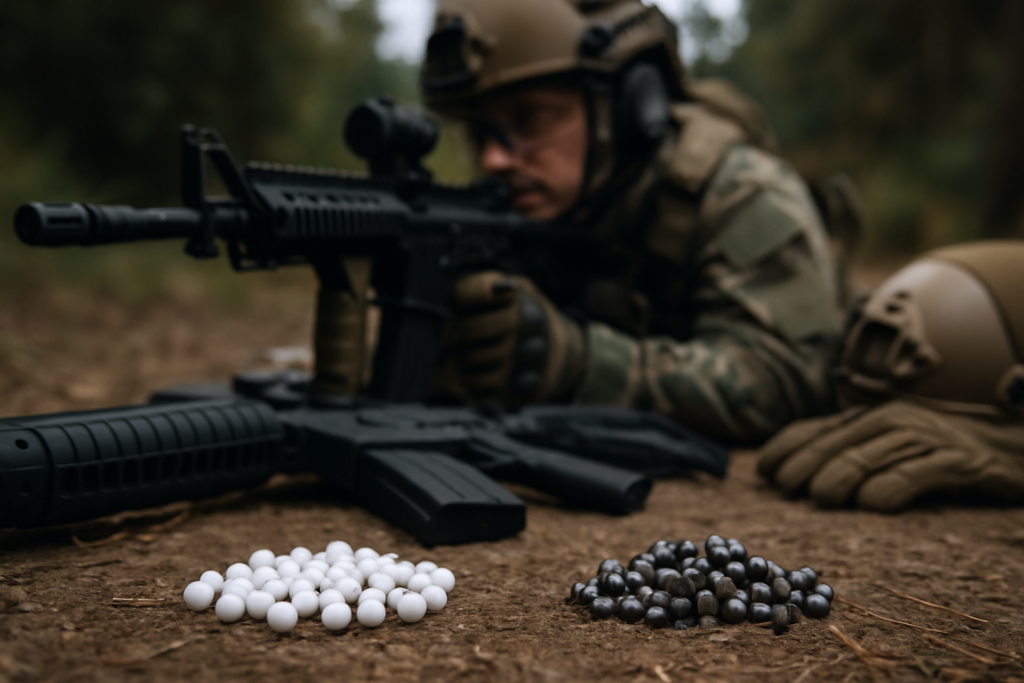
BB vs Pellet is not a close call for most airsoft players: if you play skirmishes, train with an airsoft gun, or shop for field-legal ammo, BBs are the right choice almost every time. Pellets belong to airguns, not standard airsoft games, and the differences in safety, barrel design, accuracy expectations, and field rules matter far more than simple speed claims.
| Category | BB | Pellet |
|---|---|---|
| Main use | Airsoft games, training, plinking with airsoft guns | Airguns for target shooting, pest control where legal, hunting where legal |
| Typical material | Plastic, often biodegradable for outdoor play | Usually lead or lead-free metal alloy |
| Shape | Round sphere | Skirted, waisted projectile |
| Barrel match | Smoothbore airsoft barrels and hop-up systems | Rifled airgun barrels |
| Field legality | Standard and expected | Usually prohibited in airsoft |
| Safety profile for games | Designed for lower-impact sport use | Much less suitable for player-vs-player games |
| Accuracy source | Hop-up, BB quality, barrel consistency | Projectile shape plus rifling engagement |
| Cost in use | Sold in large quantities for frequent play | Not practical for normal airsoft game use |
| Best for | Anyone playing airsoft | Airgun users, not airsoft skirmishers |
What is BB?
In airsoft, a BB is a lightweight spherical projectile made to be fired from an airsoft gun. Most airsoft BBs are plastic, and many outdoor players choose biodegradable versions to meet field rules and reduce environmental impact. Their round shape is simple, but airsoft guns are built around that shape: magazines feed spheres reliably, inner barrels are designed for them, and hop-up units apply backspin to help stabilize flight.
That point is crucial. Airsoft performance is not just about the projectile alone. It is about the whole system working together: the gun, the barrel, the hop-up, the magazine, and the weight and quality of the BB. A good airsoft BB is consistent in diameter, smooth in finish, and matched to your gun’s power level and intended range. Heavier BBs are often preferred for better stability, but the right choice depends on your replica, site limits, and role.
For airsoft players, BBs are also the standard because they fit the rules and expectations of the sport. Fields chrono airsoft guns with BBs, players buy eye and face protection around airsoft impact expectations, and retailers stock BB weights and materials specifically for skirmish use. If you need to check whether a setup stays within site energy limits, a tool like an muzzle energy calculator is useful, but the baseline assumption is still that you are firing airsoft BBs.
What is Pellet?
A pellet is a different kind of projectile, usually used in airguns rather than airsoft guns. Instead of being spherical, a pellet typically has a waisted body and a hollow skirt. That shape is made to work with rifled barrels, where the pellet engages the rifling and benefits from spin stabilization in a very different way than an airsoft BB does.
Pellets are commonly made from lead or lead-free metal alloys. They are intended for air rifles and air pistols used for target shooting, precision practice, and in some contexts hunting or pest control where local law allows it. In other words, pellets are built for a different category of shooting entirely. The goals are usually higher precision and greater retained energy than airsoft, not safe player-to-player recreational hits.
Some new players confuse BBs and pellets because both are fired by compressed air or gas in certain products, and some stores sell airsoft and airgun items side by side. But from a practical airsoft perspective, they are not interchangeable. A pellet is not simply a heavier BB. It is a different projectile for a different platform, with different safety implications, different legal considerations, and different use cases.
BB vs Pellet: Head-to-Head
1. Safety for player-vs-player use
This is the most important part of the comparison for any airsoft player. BBs are the accepted projectile for airsoft because the sport, its protective gear standards, and its field rules are built around them. That does not make them harmless, but it does make them appropriate for a controlled game environment when used responsibly and within site limits.
Pellets are another matter. Because pellets are commonly metal and intended for airguns, they are generally not suitable for shooting at other players in an airsoft setting. Even if an individual airgun seems modest on paper, the projectile type itself changes the risk profile. That is why airsoft fields usually ban pellets outright. If your main question is, “Can I use pellets in an airsoft game?” the practical answer is no.
For beginners, this one factor alone often settles the debate. If your goal is skirmishing, go with BBs and an actual airsoft platform. Pellets belong outside normal airsoft gameplay.
2. Compatibility with guns and barrels
Airsoft guns are engineered around spherical BBs. Feeding systems, buckings, nozzles, and hop-up units all depend on that shape. Even high-end airsoft builds still rely on the same basic idea: a round projectile, a consistent air seal, and a hop-up patch applying backspin.
Pellets, by contrast, are meant for airguns with rifled barrels. Their shape is designed to seal and engage differently. Trying to compare the two purely by projectile weight or advertised velocity misses the point because each one works in a separate mechanical system. An airsoft gun is not improved by switching to pellets; it is simply the wrong tool for that projectile. Likewise, an airgun intended for pellets is not a proper substitute for an airsoft skirmish rifle.
If you are shopping and the product listing mentions pellets, that is a strong sign you are looking at an airgun product rather than a field-legal airsoft gun. That distinction matters before you spend money, especially if you want something you can actually bring to a site.
3. Accuracy and effective use
Accuracy is where many people assume pellets automatically win. That is true in the context they are designed for: a quality airgun shooting pellets from a rifled barrel can deliver a level of precision that standard airsoft equipment is not built to match. But this does not mean pellets are the better choice for airsoft players. It means they serve a different purpose.
Airsoft accuracy is judged by practical game performance: can the gun place BBs consistently at common engagement distances, and can the player tune hop-up and BB weight to get stable flight? Within that framework, BBs perform exactly as intended. Better BB quality, proper hop adjustment, and suitable weight matter more than wishing for a different kind of projectile.
So the real people-first answer is this: if your goal is winning airsoft engagements and staying field legal, the relevant question is not whether pellets are more accurate in general. It is whether your airsoft setup is optimized for BBs. Almost always, that is where your attention should go.
4. Power, FPS, and energy comparisons
BB vs pellet discussions often get messy because people compare velocity numbers without context. A lighter projectile can show a higher FPS figure, while a heavier one may carry energy differently. In airsoft, responsible players should care more about muzzle energy and field compliance than about raw marketing claims. If you need help converting between FPS and joules for an airsoft build, tools like the airgun and airsoft calculators can help organize the numbers.
But even then, direct comparisons between BB guns and pellet guns are limited. They are often measured under different expectations, with different projectile weights, and for different end uses. A pellet gun can be marketed in a way that sounds similar to an airsoft gun, yet functionally it may be far more powerful or simply unsuitable for any skirmish context.
For airsoft players, the right takeaway is simple: use BBs, know your site limits, and judge your replica by safe, legal, game-relevant performance. Do not assume a pellet platform is an “upgrade” because of a speed number on the box.
5. Cost per game and ongoing use
BBs are practical for airsoft because they are sold in the quantities players actually use. A regular skirmish day can involve a lot of shots, especially for AEG users and support roles. The market reflects that reality with a wide range of BB options, from budget training ammo to premium polished biodegradable rounds.
Pellets are not part of that normal airsoft economy. Even if you ignored the safety and rules issues, pellets do not fit the way most airsoft games are played. The category is aimed more at deliberate target shooting than at high-volume skirmishing. That makes pellets a poor match for players who need affordable, field-appropriate ammunition for repeated game days.
A better cost question for airsoft players is not BB versus pellet, but which BB quality level and weight make sense for your gun. Cheap, low-quality BBs can create feeding problems and inconsistent flight, while better-made BBs can improve reliability and reduce frustration. Spend within your budget, but do not chase false savings with ammo unsuited to your platform.
6. Maintenance and wear
Because airsoft guns are designed for BBs, using decent-quality BBs usually keeps maintenance straightforward. You still need to clean the barrel, inspect magazines, and maintain seals and hop-up components, but that is ordinary airsoft ownership. The biggest ammo-related problems usually come from poor BB quality, damaged BBs, or choosing the wrong weight for the setup.
Pellets are part of a different maintenance picture. Airguns intended for pellets often have their own cleaning routines, barrel expectations, and handling considerations tied to metal projectiles and rifled bores. That is not inherently bad; it is just not the same system. If your goal is easy support, parts availability, and field familiarity, standard airsoft gear and BBs are much simpler to manage.
For a beginner, that simplicity matters. It is easier to get advice on BB weight, hop tuning, magazine issues, and chrono compliance from airsoft communities than to bring a pellet-based platform into a space where it does not belong.
7. Availability, rules, and buying mistakes
One of the most common problems behind the BB vs pellet question is buying the wrong product category. Many first-time shoppers search for “BB gun” and end up looking at a mix of airsoft guns, steel-BB guns, and pellet airguns. Those are not interchangeable in use or rules.
If you want to play at an airsoft field, always check that the gun is explicitly sold as an airsoft gun and uses 6mm BBs. Also verify your local site’s rules on biodegradable BBs, weight limits, and chrono standards. If the product fires pellets, treat it as an airgun item, not a skirmish-ready alternative.
This is also where local law matters. Airsoft and airguns may be regulated differently depending on where you live. Transport, storage, age restrictions, and allowed places of use can vary. Before buying, check both your local regulations and your chosen field’s policies.
Which Should You Choose?
For most readers of an airsoft comparison article, the answer is clear: choose BBs. Pellets are for a different discipline and should not be treated as a substitute for airsoft ammunition.
Choose BB if …
- You want to play organized airsoft games.
- You need ammo that is field legal and widely accepted.
- You are buying an AEG, GBB pistol, spring sniper, or HPA airsoft setup.
- You want a projectile matched to hop-up systems and smoothbore airsoft barrels.
- You need practical, repeatable skirmish performance rather than airgun-style target precision.
- You want easier access to guides, spare parts, and tuning advice from the airsoft community.
Choose Pellet if …
- You are not buying for airsoft skirmishes at all.
- You specifically want an airgun for target shooting or other legal airgun use.
- You understand that pellet guns are generally not appropriate for shooting at other players.
- You are shopping for a rifled-barrel air rifle or air pistol rather than an airsoft replica.
- You have checked the legal and practical differences between airguns and airsoft products in your area.
If you are still undecided, ask yourself one plain question: do I want to play airsoft with other people, or do I want an airgun for non-airsoft shooting? If the answer is airsoft, buy an actual airsoft gun and use quality BBs. That route is safer, simpler, more legal at organized sites, and far more aligned with what the sport expects in 2026.