
5 Best Hearing Protections for Indoor Range – Complete Guide (2026)
Ever left an indoor range with your ears ringing and wondered if there’s a smarter way to protect your hearing without losing situational awareness?
Indoor ranges are a different animal — tight quarters, reflections, and repeated impulse noise demand gear that balances raw attenuation, comfort, and communication. This guide breaks down five top hearing‑protection options, from high‑fidelity electronic over‑ears for competition to tactical comms muffs, budget electronic models, ultra‑slim low‑profile cups, and custom‑molded in‑ear plugs.
Each option excels in a different role: some prioritize crystal‑clear ambient amplification, others deliver maximum passive reduction, and a few offer the best value or the least interference with headgear and cheek welds. You’ll get concise product overviews, honest real‑world pros and cons, and practical indoor‑use advice on plugs versus muffs.
There’s also a straightforward FAQ to answer the common range questions and help you decide fast. Read on to match your priorities — comfort, communication, or maximum attenuation — and learn how to test fit gear so your next session is loud only in performance, not in regret.
Table of Contents
- Sordin Supreme Pro X Hearing Protection
- Peltor Sport Tactical 500 Hearing Protection
- Howard Leight Impact Sport Hearing Protection
- Walker's Razor Slim Hearing Protection
- Decibullz Custom Molded Earplugs Hearing Protection
- Indoor Range Use
- Earplugs Versus Earmuffs For Shooting
- What People Ask Most
- Conclusion For Indoor Range Hearing Protection
1. Sordin Supreme Pro X Hearing Protection

Sordin Supreme Pro-X Active Ear Defenders ACE Edition
Professional-grade hearing protection with active noise management, comfortable seal, and clear situational awareness for demanding environments.
The Sordin Supreme Pro X Hearing Protection is a premium electronic earmuff favored by top‑level competitors for precision and competition use. It’s frequently cited by pro shooters for its balance of sound fidelity and impulse‑noise control, two features that matter when your ears take a beating in heated indoor ranges. For indoor ranges, this model delivers the clarity and reliability serious shooters rely on during long, intense sessions, making it a go‑to choice for instructors and competitors who push the clock.
Real‑world performance and features: It offers excellent sound clarity with low distortion and fast attenuation on impulse noise. The comfortable gel/foam ear seals let you hear ambient sounds naturally when there’s no impulse, so communication with teammates stays fluid. The design supports stable, secure wear during repeated head movements, which matters when you’re moving around the firing line and calling out targets.
What users & pro shooters say: It’s trusted in heavy match‑level use (survey: 17% of top PRS competitors). Reviewers note multi‑hour comfort, good voice clarity, and minimal buzzing in quiet. The combination of these factors helps keep focus during long indoor sessions.
Practical notes / Ideal users: It offers a stable fit for repeated head movement and is compatible with plugs underneath for doubling up. The design prioritizes reliability in long indoor sessions. Ideal for competitive shooters, instructors, and long indoor sessions.
Indoor-range usage realities: The Supreme Pro X balances protection with the ability to hear teammates and commands, thanks to realistic ambient amplification. In practice, you’ll notice fast response to gunshots and little fatigue even after hours of wear. This model is a solid pick for anyone who wants pro‑level protection without sacrificing communication.
Pros
- Trusted by pros for heavy use and long matches
- Excellent sound quality and realistic ambient amplification for communication
- Gel ear cups provide long‑session comfort
- Fast, reliable compression/cutoff on gunshot impulses
Cons
- Relatively heavier and bulkier than slim or in‑ear options
- More expensive; lacks some consumer conveniences (e.g., Bluetooth) vs newer models
2. Peltor Sport Tactical 500 Hearing Protection
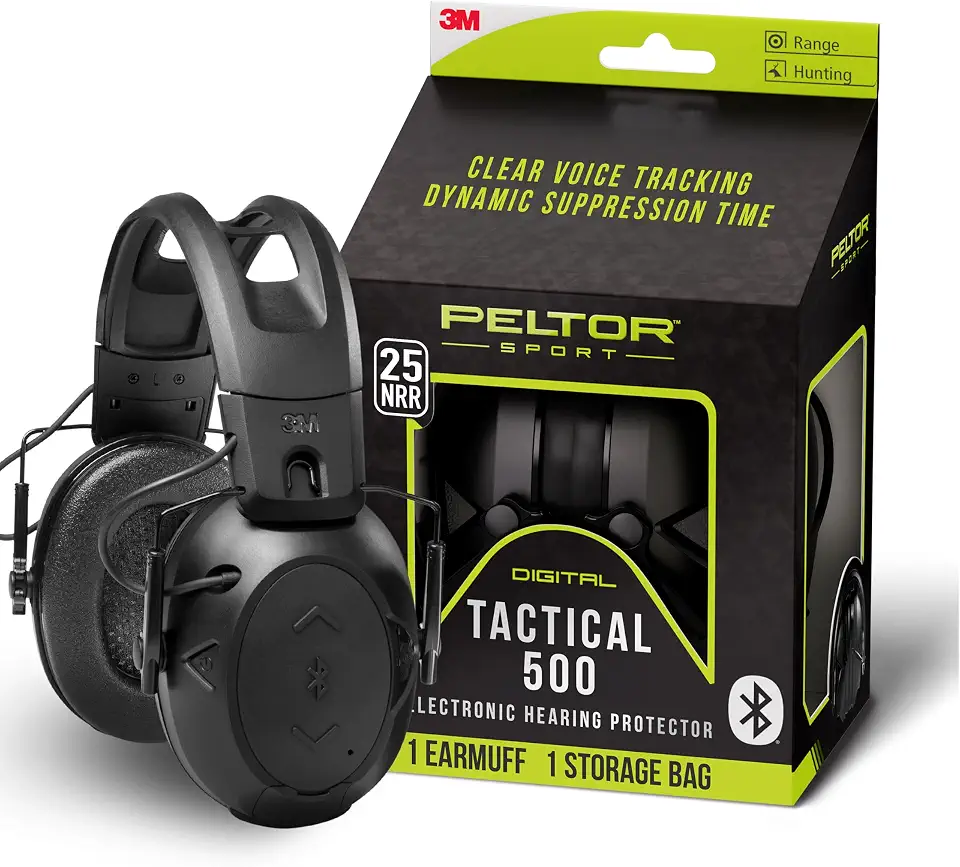
Peltor Sport Tactical 500 Bluetooth Electronic Ear Muffs, 25 dB NRR
Wireless audio and hearing protection with 25 dB attenuation, integrated comms, and rugged design for range and tactical use.
Premium electronic earmuffs in the Peltor Sport Tactical 500 Hearing Protection / ComTac family are a top pick for indoor ranges. They’re consistently recommended in range testing and roundup guides for shooters who want both serious attenuation and reliable comms. These muffs are designed to deliver high-performance protection without sacrificing the ability to hear teammates and range commands, which matters in tense indoor bays, and they keep you aware of what’s happening on the range while staying protected.
In real-world testing, they deliver superior quieting in both sound-booth and live range scenarios, with excellent internal audio quality that keeps conversations—like instruction and team calls—intelligible even during gunfire. These muffs offer multiple modes and easy integration with comms and helmet systems, so you can tailor attenuation and amplification to the day’s drills without swapping gear. The internal audio stays clear even when other equipment is mounted.
Users say they’re the go-to choice when maximum quieting and comms capability matter more than slimness or budget. That mindset makes them popular with training units and serious competitors who need dependable performance in demanding indoor environments. The reputation comes from consistent results where communication stays clear while gunshots are effectively tamed.
For practical use, they’re a go-to for static indoor ranges and frequent high-volume training. The thicker construction can feel warm during long sessions, but the trade-off is rugged durability that stands up to heavy use in busy bays. If you rely on helmet systems or comms gear, these just click into place without fighting the setup.
Pros
- Industry-leading attenuation and sound performance in tests
- Good for helmet mounting and comms integration
- Durable construction for heavy use
- Clear voice/ambient amplification without distortion
Cons
- Higher cost and heavier than slim/consumer options
- Bulk/thickness can be uncomfortable or warm during multi-hour sessions
3. Howard Leight Impact Sport Hearing Protection

Howard Leight Impact Sport Electronic Earmuff R-01526
Fast-reacting sound suppression with crystal-clear audio monitoring, lightweight comfort, and instant protection during impulsive noise.
Howard Leight Impact Sport Hearing Protection is a budget-friendly electronic muff, part of the Impact Sport / Impact Pro family, widely used for indoor range days and casual shooting sessions. It delivers clear ambient amplification and quick auto-compression to block impulses, so you can hear commands and range chatter without sacrificing protection during fast-fire sequences and quick moves on the line. Some models have gel inserts for comfort and sealed passive performance; some show no constant hiss.
Widely praised by civilian users for value and comfort; the Impact Sport is often recommended to new shooters stepping into indoor ranges. In some tests, users prefer Impact sound vs premium options in specific contexts. This makes it a versatile pick for indoor ranges where you want a balance of hearing and protection.
Lightweight and suitable for frequent range visits; can be primary ear pro for semi-regular sessions, which makes them appealing for shooters who train regularly. Pairable with passive plugs for extra attenuation. This combination gives you flexible protection depending on how loud the range gets.
As a budget option, the NRR and electronics are not as robust as top‑end models. Some variants lack advanced features (no Bluetooth, limited tuning). That said, for indoor ranges with standard noise, it’s a solid choice.
Pros
- Good sound amplification and reliable impulse suppression for indoor use
- Comfortable for long sessions, especially with gel inserts
- No persistent electronic hiss on some models
- Excellent value; common recreational recommendation
Cons
- NRR and electronics not as robust as top‑end tactical/pro models
- Some variants lack advanced features (no Bluetooth, limited tuning)
4. Walker's Razor Slim Hearing Protection

Walker's Razor Slim Ultra Low Profile Electronic Earmuffs
Ultra-slim, low-profile electronic muffs offering discreet protection, amplified situational sound, and foldable convenience for shooters.
Walker’s Razor Slim Hearing Protection is widely cited as a slim, value electronic muff for indoor ranges. Razor Slim and Razor Quad are known for their slim profile that fits tight indoor stalls, which helps shooters stay comfortable during long sessions.
In real-world use, it delivers effective impulse attenuation with a very slim profile. The Razor Quad adds quad speakers.
Ambient amplification is reasonable, helping you hear teammates and range officers. Some units show a low-level hiss at higher gain, but many shooters accept it for the compact size.
Users praise its slim fit, portability and cost. Instructors and casual shooters alike like the profile for quick fits and easy storage in a gear bag.
Background hiss is noted by some users but accepted for the cost/weight tradeoffs. This makes it a practical option for budget-conscious players who still want reliable impulse protection in indoor bays.
Practical notes show it’s suited to tight rifle booths or layering with headgear. There is less protrusion and cheek weld interference, which helps with aiming and comfort in confined spaces.
Consider battery life and replaceable ear pads. Plan for spare batteries and check pad condition before long sessions.
With its slim design, it’s easy to manage during long indoor sessions. The lightweight build reduces fatigue and makes it simple to share with teammates during brief drills.
Overall, Walker’s Razor Slim offers value and practical protection for indoor use. It balances protection with communication for recreational and training sessions, making it a reliable choice for regular indoor airsoft.
Pros
- Slim, low-profile design favored in tight indoor stalls
- Lightweight and comfortable for many shooters
- Good balance of protection and communication for recreational/training use
- Strong value for features
Cons
- Persistent low-level electronic hiss at higher amplification settings for some units
- Build materials and cushioning less premium than gel‑cup models
5. Decibullz Custom Molded Earplugs Hearing Protection

Decibullz Custom Molded Earplugs 31 dB NRR
Heat-moldable custom fit that seals tightly for maximum 31 dB attenuation, reusable comfort for music and noisy environments.
Decibullz Custom Molded Earplugs Hearing Protection are custom/moldable in-ear options (Decibullz, SureFire EP series) recommended as an alternative to over-ear muffs for indoor ranges. They’re designed to sit in your ears and provide a comfortable base layer of protection.
They deliver superior passive attenuation versus off-the-shelf foam, with a low-profile, comfortable fit that won’t crowd your ear canal. Proper molding is key to maximizing this benefit, and the result is a plug that stays in place during long sessions and hot indoor bays.
SureFire offers hybrid caps/pass-through options, and custom plugs enable plug+muff double-up for maximum protection. Decibullz plugs also play nice with other headgear because SureFire offers hybrid caps/pass-through options; custom plugs enable plug+muff double-up for maximum protection. So you can wear the plugs alone or pair them with muffs for extra attenuation without getting bulky.
Decibullz rated best in earplug shooting tests. Pros favor custom in-ear for comfort and coolness during long matches. Preferred when wearing helmets or vests, or to avoid muff interference.
Favored in hot, close-quarter indoor days or when other headgear is used, they can be left in for long training sessions. Communication limited unless using electronic in-ear models; requires cleaning and proper molding.
On the practicality side, these plugs stay in during long sessions and hot bays, making them ideal for intensive indoor days. Just remember, communication may be limited unless you’re using electronic in-ear models, and you’ll need to keep up with cleaning and proper molding. All told, Decibullz offers a compelling balance of comfort, attenuation, and compatibility to suit many indoor range setups.
Pros
- Superior long‑wear comfort and cooler for extended indoor sessions
- Excellent passive attenuation when properly fitted
- Low profile — doesn’t interfere with headgear or cheek welds
- Compatible with muffs for double protection
Cons
- Less situational awareness/voice clarity than electronic muffs unless using electronic in-ear models
- Hygiene and fit issues if not molded correctly; requires care and occasional remolding/replacement
Indoor Range Use
Indoor ranges bounce noise around, and a simple misstep can leave you with ringing ears after a long day of drills, resets, and hurried sprints. Choosing between plugs and muffs isn’t just comfort—it shapes how you train and, crucially, how long you’ll stay effective behind the line. Understanding when to reach for plugs or electronic muffs keeps you sharp, saves you from fatigue, and protects your hearing over the long haul.
Ear plugs generally deliver the strongest protection indoors, and when fitted correctly they can reach 32+ NRR, easily outpacing many over‑ear muffs against echoes. When properly sealed, they stay tight to the canal, offering excellent attenuation without adding bulk or heat buildup. Pairing plugs underneath a set of electronic muffs gives you a dual layer of protection for the busiest drills.
Electronic muffs shine for communication and situational awareness, letting you hear teammates without pulling protection off, which keeps drills flowing smoothly. They amplify speech and ambient cues while actively reducing gunfire impulses, so you can stay in the loop with range officers and squad leaders. Best of all, most electronic muffs snap on and off quickly and are easy to share between teammates.
Solo benchrest shooters typically lean toward plugs for maximum attenuation and zero interference with the rifle stock. For team training days, electronic muffs let you hear commands clearly without removing protection. In hot indoor bays or long sessions, plugs stay cooler and lighter, while you can add muffs for brief bursts of extra quiet or to hear teammates more clearly.
Bottom line: choose by your top priority—raw protection or clear communication. Test fit across a typical range day and consider doubling up when you know you’ll face louder calibers. Stick with the setup that stays comfortable for long sessions and use it consistently to protect your hearing.
Earplugs Versus Earmuffs For Shooting
Indoor ranges demand a practical approach to hearing protection. Earplugs and earmuffs each bring something useful to the table. In most setups, plugs deliver the strongest noise shut-off, while electronic earmuffs let you hear commands and teammates without letting gun blasts overwhelm you. The right combo keeps you safe and focused from the first drill to the last reload.
Earplugs offer several real-world advantages. When properly seated, quality plugs can deliver substantial attenuation—often higher than many earmuffs in the same environment. They stay cooler in tight bays and don’t trap heat around the ears, a big deal on long sessions. They’re slim enough not to interfere with the rifle stock, cheek weld, or slings. For extra protection, you can layer by wearing plugs under electronic earmuffs.
Earmuffs have their own strengths. They slip on and off quickly, a huge help for fast drills or sharing protection in a squad. The electronics can amplify speech and ambient sounds, so you pick up commands while keeping impulse protection intact. The cups are large enough to accommodate glasses and rough handling, and they tend to be rugged for busy ranges. They’re less flattering for a hot day, but the convenience is real.
In practice, most indoor shooters use a hybrid approach. For solo bench work, plugs alone give maximum attenuation and no stock interference. In team drills, electronic muffs shine because you can hear instructions while staying protected. For long sessions in hot bays, plugs feel lighter and cooler, though you might flip to muffs when you need to talk between reps. For high-noise pistols, layering—plugs under muffs—offers the strongest protection. Test-fit each option and practice swapping quickly so protection stays consistent. The most important thing is consistency—protect your hearing every time you step on the range.
What People Ask Most
What is the best hearing protection for indoor shooting ranges?
There isn’t a single best option for every shooter; you’ll want to match your choice to your priorities. Ear plugs generally provide higher noise reduction indoors, while electronic earmuffs help with communication and ambient hearing.
How do you choose hearing protection for an indoor range?
Focus on your priorities: raw protection or comfort versus easy communication. The guide suggests plugs for maximum attenuation and muffs for easier use and better voice amplification. Test fit personally and use your protection consistently to guard against hearing damage.
Are earmuffs better than earplugs for indoor shooting ranges?
The two have different strengths: ear plugs provide higher protection and cooler comfort in tight spaces, while earmuffs offer easier use and ambient sound amplification. The choice depends on whether you prioritize maximum attenuation or instant usability and communication.
What noise reduction rating (NRR) is recommended for indoor shooting ranges?
Ear plugs often provide higher protection levels, sometimes achieving around 32+ NRR. Ear muffs offer alternatives like easy use and amplification, but may not reach the same attenuation in all scenarios. Choose based on your priorities and fit.
Should you use electronic hearing protection for indoor ranges?
Electronic protection helps with communication and ambient hearing while still reducing impulse noise. It amplifies speech and low-level sounds while cutting gunshot impulses. Use it if clear communication and situational awareness are important to you.
Is double protection (earplugs plus earmuffs) recommended for indoor ranges?
Double protection can be used for the highest-risk sessions. Layering plugs under earmuffs can boost attenuation while still maintaining some amplification and communication where possible. Use it selectively based on your risk level and the noise environment.
How should you properly fit hearing protection for shooting at an indoor range?
Test fit personally to ensure you achieve a comfortable seal and effective protection. Use and re-check your setup routinely to maintain consistent coverage and comfort during sessions.
Conclusion For Indoor Range Hearing Protection
This conclusion reinforces the guide’s core value: indoors, listening protection should fit your priorities. Premium/pro options deliver sound fidelity for serious shooters, value/slim models offer portability, and custom in-ear solutions maximize comfort and passive attenuation.
Match your indoor priorities to your protection choice—comfort, communication, or maximum attenuation—and test fit to ensure reliable protection. For the highest-risk sessions, double protection (plugs plus muffs) is worth considering.
The framework helps you balance protection with practical use in crowded bays and during long training days.
For ongoing improvement, read more articles on the site to sharpen your techniques and protection decisions. Leave a comment with your experience; we usually reply within a few hours.