
5 Best Scopes for .177 Air Rifles – What To Buy (in 2026)
Which scope will turn your .177 into a tack-driving small-game hunter or a competition-ready target rig this season?
This guide cuts through the murk and points you to the five best scopes for .177 air rifles in 2025. I tested popular options and narrowed the field to five picks that deliver real-world performance for typical airgun missions.
One pick favors dead-on precision for bench and field-target work. Another is tuned for hunters who need crisp glass and quick target ID at dawn and dusk. A third excels at long-range plinking and extended-yardage shots, while a compact, lightweight option suits stalk-and-shoot scenarios. The final choice is a true multi-purpose scope for shooters who want one optic to do many jobs.
Throughout this article you’ll get clear guidance on which style of scope matches common .177 roles and why each choice fits its intended shooter. Expect practical, experience-based recommendations rather than marketing-speak, with an eye toward how scopes behave on real air rifles in the field.
If you want sharper groups, easier zeroing, and fewer surprises on a hunt or at the range, keep reading—your ideal .177 scope is one short read away.
Table of Contents
1. Athlon Argos BTR Gen2 6-24×50

Athlon Optics Argos BTR Gen2 6-24×50 FFP Riflescope
Precision first focal plane scope with versatile 6–24x magnification, crisp glass and robust construction for long-range accuracy.
Athlon Argos BTR Gen2 6-24×50 is built for serious precision on .177 air rifles. In real-world box tests, it delivered 99.8% tracking and tight groups, with 0.3 MOA at 50 yd and 0.5 MOA at 100 yd. The scope uses an APLR2 first-focal-plane MOA reticle that scales across magnifications, so you can use the same holdovers from 6x to 24x while glass clarity remains sharp for target ID at 100 yd.
Eye relief stays steady from 3.2–3.4 in across the zoom range, helping prevent scope shadow on springers. Turrets provide precise tactile adjustments with a reliable zero stop, making quick re-zero possible after transport or rough handling. The reticle remains usable at all magnifications during dynamic shooting, which is essential when you’re dialing in holdovers on the fly.
Best for precision shooters and long-range plinkers on PCP or high-powered springers needing FFP holdovers. The glass clarity and holdover capability pair well with high-powered rigs, giving you an edge in low-light and extended-range shots. Weight and bulkier profile are trade-offs on lighter or more compact platforms, so consider your rifle’s balance before committing.
Pros
- Reticle usable at all magnifications during dynamic shooting.
- Consistent sub-MOA groups at 50–100 yd despite pellet inconsistencies.
- Fast re-zeroing via zero stop after transport/rough handling.
- Low-light glass performs well on small game at extended ranges.
Cons
- Weight causes noticeable front-heaviness on lighter .177 rifles.
- Bulkier profile shifts balance on compact air rifles.
2. Vortex Viper HD 5-25×50 FFP

Vortex Optics Razor HD Spotting Scope
Ultra-high-definition spotting optic delivering exceptional clarity, contrast, and field detail for birding, target spotting, and long-range observation.
Excellent close-range focus for pest control at 10–50 yd, giving you reliable hits on fast-moving targets even when brush or tall grass tries to hide them. The elevation adjustments are tactile and paired with a solid zero stop for field dialing, so you can re-zero confidently after transport or rough handling. Sharp glass and good low-light performance into shadows help you pick up subtle movement at dawn or dusk, when pests are most active.
Reticle holds zero through magnum recoil; wide FOV aids tracking in woods, letting you follow erratic movements without losing sight of your target. Consistent at 50–100 yd on field target rifles, with windage less precise under rapid adjustments, meaning you should plan quick corrections carefully. This pairing gives you a versatile option for PCP platforms that tackle both pest control and field targets without swapping optics.
Best for precision air rifle enthusiasts and hunters who need versatile magnification on PCP platforms, the Viper HD adapts from close work to mid-range shots with ease. The 10–50 yd close-range focus and 50–100 yd consistency described above ensure you’re covered in typical backyard and field scenarios. The reliable holdovers and crisp glass across the magnification range help you stay on target as you range and shoot.
On PCP platforms, you gain reliable holdovers and a clear sight picture across the magnification range. This makes it a solid choice for players who want one optic to handle varied targets, from pests to field targets, without sacrificing reliability or speed.
Pros
- Zero stop and elevation turret enable precise holdovers for pellet drops.
- Close-focus without parallax creep during movement.
- Low-light clarity reveals fine details on fur/movement.
- Holds zero on high-recoil setups after hundreds of shots.
Cons
- Windage feels mushy; minor drift during windy corrections.
- Reticle can overwhelm in very close, quick shots on moving targets.
3. Hawke Airmax 30 SF 8-32×50
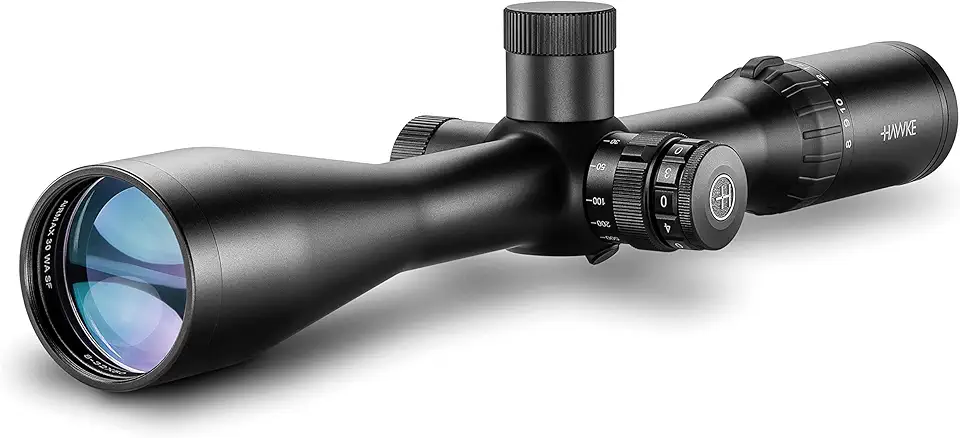
Hawke Airmax 30 SF 8-32×50 30mm IR Scope
Compact airgun scope with wide 8–32x range, illuminated reticle and durable tube for precise shots and easy target acquisition.
The Hawke Airmax 30 SF 8-32×50 Air Rifle Scope is built for serious spring-piston .177 rifles, delivering hunting and plinking performance out to 100 yards with repeatable consistency. Across the magnification range, it maintains crisp edge-to-edge clarity and retains excellent reticle visibility, so you can track small hits without guesswork. Minimal parallax and precise turrets support reliable holdovers, though turret caps can be finicky when moisture is high; wipe them dry before dialing.
Tight groupings at 50 yd and consistent results at 100 yd with JSB Exact Heavy Diabolo pellets showcase its precision in real-world wind. High magnification lets you see pellet impacts clearly, enabling fine-tuning of sight picture and wind holds for longer-range shots. Parallax remains minimal, and the holdover turrets perform predictably, though you should protect turret caps in wet weather to prevent corrosion or slippage.
This scope is reliable on spring-piston .177 rifles for hunting and plinking out to 100 yd, making it adaptable from casual shooting to field targets. With high magnification, you can clearly see pellet impact details, which simplifies tuning and helps you judge wind and range. An illuminated reticle stays visible in low-light dusk hunts, preserving contrast and helping you pick off targets without getting lost in the dark.
For versatility, the Hawke Airmax 30 SF is an excellent choice for both hunters and target shooters who demand high magnification on mid-to-high powered air rifles. If precise, repeatable groups at distance and clear target visibility are your priorities, this scope delivers. Keep in mind turret caps in wet weather and the potential for mirage under hot conditions at maximum power.
Pros
- Tight, repeatable groups at extended ranges with heavy pellets in wind.
- High magnification shows pellet impact details for tuning.
- Stable parallax during offhand/rested shots on uneven terrain.
- Illuminated reticle visible for low-light dusk hunts without bloom.
Cons
- Turret caps fiddly to secure quickly after rain or dew.
- High magnification amplifies mirage on hot days, blurring distant targets.
4. Element Titan 3-18×50 FFP

Element Titan 3-18×50 FFP Air Rifle Scope
Lightweight first-focal-plane optic offering 3–18x versatility, clear glass and recoil-rated build ideal for air rifles and field use.
The Element Titan 3-18×50 FFP Air Rifle Scope is built for serious field use on .177 air rifles. Its ergonomic controls and compact design keep you comfortable all day.
A wide field of view helps you track small game from 50 to 100 yards. The optics stay clear in low light, making dawn and dusk easier to read movement.
With 3-18×50 magnification, you get versatile engagement from close quarters to mid-range shots. Reticle scales provide precise .177 pellet holdovers, and the scope offers reliable no-zero-shift use on big-bore setups.
The compact design balances well on .177 rifles and reduces fatigue during long treks. Ergonomic controls support quick adjustments in dynamic field scenarios.
A wide field of view aids fast target acquisition in brushy areas. Low-light performance helps discern movement when light fades.
Low-light glass discerns movement and details in shaded woods. The controls permit quick magnification changes in busy moments.
For PCP hunters, this scope fits multi-purpose uses from pests to small game. It delivers solid field performance without overkill in weight or bulk.
Built to handle field abuse, it remains reliable without sacrificing clarity. The no-zero-shift trait during rough handling adds to its rugged reputation.
Compact size balances well on .177 rifles and supports extended carry through long sessions. You’ll notice the light weight and rugged build in real hunts.
Despite precision features, the Titan remains approachable for day-to-day use. It provides a dependable platform for target work, pest control, or small-game hunting.
In short, the Element Titan 3-18×50 FFP is a versatile optic with holdovers, clarity, and reliability on .177 PCP rigs. It’s ready for real-world field use.
Pros
- Compact size balances well on .177 rifles for extended carry.
- Wide FOV aids fast target acquisition in brushy areas.
- Low-light glass discerns movement and details in shaded woods.
- Controls permit quick magnification changes in dynamic field scenarios.
Cons
- Turret tracking occasionally requires verification after heavy recoil sessions.
- FFP reticle appears thin at low power for very close snap shots.
5. MTC Optics King Cobra 6-24×50 F1

UUQ 6-24×50 AO Rifle Scope Illuminated Red/Green Reticle with 20mm/11mm Mounts
Adjustable objective riflescope with 6–24x magnification, dual-color illumination and included mounts for fast, adaptable mounting solutions.
Meet the MTC Optics King Cobra 6-24×50 F1 Air Rifle Scope, a scope built for long-range work on .177 air rifles. It delivers precise tracking for 100+ yd shots and features an illuminated reticle that stays visible across varied lighting, so you can keep the crosshairs on target when light fades. The glass is sharp and the turrets are smooth, making wind and elevation dialing predictable—crucial when you’re dialing in for field target and long-range plinking. That illumination helps you maintain a crisp aiming point as ambient light shifts, critical when you’re tracking distant reactive targets.
Zero hold is reliable after thousands of pellets and rough field use. That means you can shift your shot plan with confidence and know the reticle will stay on zero through long sessions on breezy days or rough terrain. The illumination helps in dawn and dusk without washing out the aiming point, so you can stay precise when light gets tricky.
For dedicated long-range shooters targeting distant pests or reactive targets, this scope really earns its keep. Its combination of precise tracking and robust dialing makes it popular for field target and long-range plinking. If your goal is consistent distance shots with varied-light conditions, the King Cobra is a strong match for your air rifle setup.
Best for those chasing long-range accuracy with an eye on durability and ease of use. While it excels at distance, it does come with a narrower field of view at max power and extra weight that can affect maneuverability on lightweight .177 rifles during stalks.
Pros
- Accurate tracking for consistent long-range hits despite pellet variability.
- Illumination enables precise aiming at dawn/dusk without washing out.
- Smooth turrets for quick wind corrections; holds adjustments through extended sessions.
Cons
- Narrower field of view at max power slows target location in open fields.
- Weight impacts maneuverability on lightweight .177 rifles during stalks.
Choosing a Scope for .177 Air Rifles
Choosing a scope for a .177 air rifle means balancing the rifle’s flat trajectory with a reticle you can actually use at field ranges. Because .177 pellets maintain higher velocity than heavier calibers, you’ll see less drop, so you should focus on parallax control, reliable holds, and glass that stays sharp from 10 to 50 yards.
Opt for adjustable parallax (AO or side focus) starting around 9–10 yards. This keeps the reticle crisp as you swing from cover to target and helps when dialing in at 50 yards and beyond. For precision, pick an etched reticle—mil-dot or grid—so you can estimate range and hold for wind without chasing a fiber optic that can blur under spring recoil.
On reticle type: first‑focal-plane (FFP) reticles let you read holdovers in any magnification; second‑focal-plane (SFP) reticles stay the same subtensions, but are easier to read at fixed distances. If you’re chasing long-range shots or wind holds, FFP is the better choice.
Magnification should match your common engagement ranges. A low-to-mid setup (3–9x or 4–12x) covers 25–35 yards in a backyard or small field. For longer shots or benchrest-style plinking, you’ll want higher magnification—up to 30x or more—so you can see pellet impact details and tune your holdovers.
Lightweight, 40–44 mm objectives strike a good balance between light gathering and weight. Bigger isn’t always better; heavier scopes can throw off balance on compact rifles. Also, look for an airgun-rated scope with turret locks and a zero stop to prevent “walking” after recoil.
Finally, match the scope to your rifle’s role. A compact, lighter scope suits hunting and quick target acquisition, while a larger scope with robust zero stops works well for field targets or benchrest-style shooting. With these checks in mind, you’ll pick a scope that complements your .177 air rifle and keeps you ready for any backyard or field challenge.
Mounting Tips for .177 Air Rifle Scopes
Mounting a scope on a .177 air rifle is half the battle won if you start with hardware that matches your setup. Use mounts that fit your rail type (dovetail or Picatinny) and match your scope’s tube diameter. Choose a mounting height that clears the barrel and leaves room for the cheek weld while keeping the scope aligned with the bore for proper balance and not fighting recoil.
With a 40 mm+ objective, go with higher rings; ensure the scope sits parallel to the bore to avoid binding under recoil.
When possible, aim to center the erector tube mechanically before sighting to simplify zeroing at your typical 25–30 m. That means keeping windage and elevation centered so you can dial in cleanly at range.
Apply even torque to mount screws with a torque wrench; consider thread locker for vibration resistance. This isn’t a casual setup—your scope will take a beating on a springer or high-recoil PCP.
Set comfortable eye relief (typically 3–4 in) with a proper cheek weld; level the rifle and scope with a bubble level to avoid cant that throws you off at distance.
For springers, use spring-tested mounts with stop/recoil pins to absorb forward whip. It keeps the zero consistent after long days of shooting.
Bore-sight first, then fine-tune at the range; check parallax by moving your head side-to-side to ensure the reticle stays on target. This is crucial for fast follow shots at 25–50 m.
Finally, re-check mount tightness after a day on the field, as airgun recoil can cause “walking” of the reticle or shifts in zero. A quick torque check and realignment will save you time when wind and grass come into play.
What People Ask Most
What is the best scope for a .177 air rifle?
Finding the best scope depends on your rifle and intended use. Look for a scope that is compatible with spring recoil and suits the type of shooting you plan to do. Your choice should balance durability, reliability, and ease of use.
What magnification is best for a .177 air rifle scope?
Choose magnification based on the typical distances you shoot and your goals. A lower to mid range is often suitable for close targets, while higher magnification is useful for longer-range work. If you are unsure, start with a versatile setup.
Do air rifle scopes require parallax adjustment?
Parallax adjustment helps keep the reticle sharp at varying distances. Many air rifle scopes include adjustable parallax to maintain accuracy during movement. If your scope has this feature, set it to the typical working distance you plan to shoot.
Can I use a regular rifle scope on a .177 air rifle?
Not all rifle scopes are suitable for air rifles. Check for compatibility with spring recoil and mounting options, and consider dedicated airgun scopes if needed. Using an inappropriate scope can affect accuracy.
What reticle is best for a .177 air rifle scope?
Etched reticles are generally preferred for durability under recoil. The best reticle also depends on your use, with styles like mil-dot or grid aiding range estimation and wind holds. Choose a reticle that stays clear during movement and changing light.
How do I mount and zero a scope on a .177 air rifle?
Follow proper mounting steps to ensure a solid setup. Make sure the mounts fit your rifle rail and scope tube, and center the erector tube before zeroing. Then tighten screws evenly and perform bore sighting at a practical distance before fine tuning at the range.
What features should I look for in a scope for a .177 air rifle?
Look for compatibility with spring recoil and a reliable parallax adjustment. A durable reticle and glass, plus features like turret locks or zero stops, help with accuracy. Choose a magnification range that matches how you will use the rifle.
Conclusion for Best .177 Air Rifle Scopes
This conclusion highlights how five scopes each bring distinct strengths for .177 air rifles, with the best choice depending on your rifle type and shooting context.
The Athlon Argos BTR Gen2 is ideal for precision and long-range work on PCP or springers, with reliable tracking and clear glass, though its weight can affect balance on lighter rifles.
The Vortex Viper HD excels for close-range pest control and versatile field targets, offering a solid zero stop and reliable holdovers, though windage can feel less precise during rapid adjustments.
The Hawke Airmax 30 SF offers high magnification, crisp reticle visibility, and stable parallax for hunting and precision plinking, though high magnification can amplify mirage and the turret caps can be finicky in wet weather.
The Element Titan 3-18×50 FFP is a compact, ergonomic option for multi-purpose use on PCP rifles, with a wide field of view and strong low-light performance, though turret tracking may need occasional verification after heavy recoil.
The MTC Optics King Cobra provides precise long-range tracking, reliable zero holds, and an illuminated reticle for dawn and dusk, making it solid for distant targets, though its narrower field of view at max power and extra weight can hinder quick movements.
To pick the best fit, match the scope to your rifle type (springer vs PCP), your desired magnification and parallax range, reticle preference, and mounting compatibility.
To sharpen your game further, explore more articles on our site for practical tips and field-tested insights. Leave a comment below; we usually reply within a few hours.