
Taurus PT99 Airsoft Pistol Review – Is It Still Worth It in 2026?

Wondering if the Taurus PT99 is still a good airsoft sidearm for skirmishes, CQB games, and realistic training drills?
The PT99 is a full-size gas blowback airsoft pistol inspired by the classic Beretta-style service pistol layout. It offers realistic weight, a metal slide, adjustable hop-up, and a stable grip that makes it feel more substantial than many lightweight sidearms.
This review focuses on what matters in real airsoft use: handling, accuracy, gas performance, magazine capacity, holster fit, upgrade potential, and whether the PT99 makes sense compared with popular M9-style and Glock-style alternatives.
The short version: the Taurus PT99 is not the most modern or modular airsoft pistol, but it can be a very enjoyable choice if you want a realistic, full-size GBB sidearm with classic ergonomics and steady follow-up shots.
Keep reading for the full breakdown.

Hogue Grip Panels
Textured grip panels can improve traction, comfort, and control on compatible pistol platforms. They are useful if you want a firmer hold during fast transitions, sweaty conditions, or long training sessions.
Table of Contents
- The Numbers You Need
- How It’s Built
- In Your Hands
- My Experience Using The Taurus PT99
- Accuracy, Range, And Hop-Up
- Gas Efficiency And Reliability
- The Good and Bad
- Ideal Buyer
- Taurus PT99 vs Beretta M92 Airsoft Pistols
- Best Accessories For The Taurus PT99
- Better Alternatives?
- What People Ask Most
- Conclusion
The Numbers You Need
| Spec | Value |
|---|---|
| Model | Taurus PT99 |
| Type | Full-size gas blowback airsoft pistol |
| Caliber | 6 mm BB |
| Power source | Green gas / propellant gas |
| Action | Semi-automatic gas blowback |
| Magazine capacity | Around 15 rounds |
| Velocity | Approximately 300–330 FPS with 0.20g BBs |
| Hop-up | Adjustable |
| Material | Metal slide with alloy/polymer frame depending on version |
| Overall length | Approximately 205–215 mm |
| Inner barrel length | Approximately 100–110 mm |
| Weight | Approximately 700–850 g unloaded |
| Sights | Fixed front and rear combat-style sights |
| Accessory rail | Short under-barrel rail on some versions |
| Muzzle thread | Usually not externally threaded |
How It’s Built
The Taurus PT99 follows the classic Beretta-inspired service pistol shape, which gives it a familiar full-size profile and a very natural point of aim. It is not a tiny backup pistol or a competition-style speed gun. It is built more like a traditional duty sidearm, and that is exactly why many players like it.
The first thing you notice is the size and weight. The PT99 feels more substantial than many cheaper polymer airsoft pistols, especially because of the metal slide and longer frame. That added mass gives the pistol a stable feel during presentation and makes the blowback cycle more satisfying when shooting.
The grip shape is one of its strongest points. It fills the hand well, gives enough surface area for a secure two-handed grip, and makes the pistol easy to control during quick follow-up shots. Players with smaller hands may find it a little large, but most adult players who like full-size pistols will appreciate the classic ergonomics.
The adjustable hop-up is important because it lets you tune the BB flight for different BB weights and playing conditions. With a properly adjusted hop-up and good BBs, the PT99 can stay accurate enough for normal sidearm distances in CQB and short outdoor engagements.
Fit and finish are generally solid for a skirmish-focused gas blowback pistol. You may notice a small amount of slide movement or light mechanical noise if you shake the pistol aggressively, but that is common on many GBB pistols and does not automatically mean poor performance.
The under-barrel rail, depending on the exact version, gives you the option to mount a compact light or small accessory. It is not as modular as modern Glock-style platforms, but it gives you enough flexibility for basic CQB setups.
Overall, the PT99 is built for players who want realistic handling, a full-size grip, metal-slide feel, and classic service-pistol styling. It is not the most compact or high-capacity choice, but it feels stable, familiar, and satisfying to use.
In Your Hands
In the hand, the Taurus PT99 feels like a proper full-size airsoft sidearm. The weight helps the pistol settle naturally when you raise it toward the target, and the longer sight radius makes aiming feel more controlled than on very compact pistols.
The blowback impulse is firm enough to feel enjoyable without making the pistol difficult to manage. It gives you that realistic cycling feel that many players want from a gas blowback pistol, but it does not jump around so much that you lose your sight picture after every shot.
For CQB, the PT99 works best when you treat it like a deliberate sidearm rather than a spam-fire pistol. The magazine capacity is limited compared with some modern airsoft pistols, so shot discipline matters. You can absolutely use it aggressively, but you will want spare magazines if you plan to rely on it during full rounds.
The controls are straightforward. The layout feels familiar if you have used Beretta-style pistols before, and the grip angle helps with fast target acquisition. Newer players should not have much trouble learning the platform, although the larger frame may take some adjustment if they are coming from compact pistols.
Holster compatibility is mostly good with universal full-size pistol holsters, but molded holsters can be more complicated. Because some PT99 versions have an under-barrel rail or slightly different frame shape, always check holster fit before buying a rigid model.
As a backup weapon, the PT99 makes the most sense for players who want realism, stability, and classic handling. It is less ideal for players who want the lightest possible sidearm or the fastest possible draw from a minimal belt setup.
My Experience Using The Taurus PT99
The Taurus PT99 feels best when used as a realistic secondary pistol rather than a high-volume primary weapon. In CQB games, it gives you enough confidence to clear rooms, hold tight angles, and take quick shots at short distances without feeling underpowered or toy-like.
The grip is the part that stands out most during actual use. Because the frame is full-size, you can get a strong two-handed hold on the pistol. That makes a real difference when you are moving, leaning around cover, or trying to land a fast second shot after your first BB misses.
The trigger feel is usable for airsoft. It is not a match-grade experience, but it is predictable enough for skirmish distances. Once you understand the reset and how the pistol cycles, follow-up shots become easy to time.
At close range, the PT99 is very comfortable. Inside typical CQB distances, it points naturally and gives enough accuracy for center-mass shots. The fixed sights are simple, but they do the job. They are not flashy, fiber-optic, or competition-oriented, but they match the realistic service pistol feel.
Outdoors, the PT99 is still useful, but you need realistic expectations. It can reach modest outdoor distances with decent BBs and a tuned hop-up, but it is not replacing a primary rifle. It is best used when your rifle is empty, when you are moving through structures, or when field rules require a lower-powered weapon at close range.
Reloading is easy once practiced, but the magazine capacity is something you must plan around. Around 15 rounds is enough for sidearm use, but not enough for careless shooting. For serious games, I would carry at least two spare magazines.
Gas performance is usually solid in comfortable temperatures. Like most green gas pistols, performance can drop in cold weather. You may notice slower cycling, reduced consistency, or less snappy blowback when temperatures fall. This is not unique to the PT99, but it is worth knowing if you play in colder climates.
One thing I like about the PT99 is that it rewards controlled shooting. It feels better when you aim, fire, track the sights, and fire again. If you enjoy realistic pistol handling and want something with more character than a generic compact sidearm, the PT99 has a lot of appeal.
Accuracy, Range, And Hop-Up
The PT99 performs well at typical airsoft pistol distances. With quality 0.20g or 0.25g BBs, it can produce consistent shots inside close to medium sidearm ranges. For CQB, that is usually more than enough.
The adjustable hop-up is one of the most important features because it lets you fine-tune the flight path. A properly adjusted hop-up can make the pistol feel much more consistent, especially if you use heavier BBs for better stability.
With 0.20g BBs, you can expect slightly faster velocity and a flatter initial path, but 0.25g BBs may give better consistency depending on your field limits and gas setup. If your field allows it, testing both weights is the best way to find the sweet spot.
The fixed sights are basic but usable. They are not designed for precision target shooting, but they line up quickly and fit the practical role of the pistol. For fast skirmish use, that is more important than having adjustable target sights.
Do not expect rifle-like range. The PT99 is still a sidearm. Its best role is close-range backup use, indoor play, and short outdoor engagements where quick handling matters more than long-distance precision.
Gas Efficiency And Reliability
Gas efficiency depends on temperature, magazine condition, BB weight, shooting speed, and the exact version of the pistol. In normal conditions, the PT99 should run reliably enough for sidearm use, especially if you keep the magazine seals maintained and avoid rapid dumping in cold weather.
Because it uses a metal slide, it needs enough gas pressure to cycle properly. That metal slide is part of what makes the pistol feel realistic, but it also means cold weather can affect performance more than it would on some lightweight plastic-slide pistols.
During longer games, spare magazines are more important than raw gas efficiency. The PT99 is not a high-capacity platform, so you should think of it as a controlled secondary weapon. One magazine is fine for casual target shooting, but for skirmishes, two or three magazines make the pistol much more practical.
Maintenance is simple. Keep the pistol clean, use quality BBs, avoid dirty magazines, and make sure the seals do not dry out. A small amount of silicone maintenance on magazine seals can help preserve reliability over time.
The PT99 is not the most advanced gas blowback pistol on the market, but it is dependable when treated properly. Most reliability issues with this type of pistol usually come from poor BBs, dry seals, damaged magazines, or cold weather rather than the basic design itself.
The Good and Bad
Pros
- Full-size design gives realistic weight and handling
- Metal slide adds satisfying gas blowback feel
- Comfortable Beretta-style grip angle
- Adjustable hop-up helps tune BB flight
- Good choice for CQB and realistic sidearm drills
- Stable platform for controlled follow-up shots
Cons
- Magazine capacity is limited compared with newer platforms
- Full-size frame is slower to draw than compact pistols
- Aftermarket support is not as broad as Glock or Hi-Capa platforms
- Cold weather can affect gas performance
- Usually not tracer-ready or suppressor-ready out of the box
Ideal Buyer
The Taurus PT99 is ideal for players who want a realistic full-size airsoft pistol with classic service-pistol handling. If you like the look and feel of Beretta-style pistols, the PT99 will probably feel familiar right away.
It is a strong pick for CQB players who want a sidearm that feels stable, substantial, and easy to aim under pressure. The power range is usually suitable for many indoor fields, but you should always check your local FPS limits before playing.
It also makes sense for players who enjoy training-style drills. The gas blowback action, full-size grip, and metal slide make it more satisfying for draw practice, reload practice, and basic target work than a simple spring pistol.
The PT99 is less ideal for players who want maximum magazine capacity, huge aftermarket support, or a lightweight speed-focused setup. If your goal is pure performance and customization, a Hi-Capa or Glock-style GBB may be a better platform.
Buy the PT99 if you value realism, stability, classic ergonomics, and controlled sidearm performance. Skip it if you want the most modular or competition-friendly pistol available.
Taurus PT99 vs Beretta M92 Airsoft Pistols
The Taurus PT99 and Beretta M92-style airsoft pistols are closely related in feel because both follow the same classic full-size service pistol concept. They are large, stable, easy to aim, and built for players who prefer realistic handling over compact convenience.
| Feature | Taurus PT99 | Beretta M92 Airsoft Pistols |
|---|---|---|
| Handling | Stable, full-size, realistic | Stable, full-size, realistic |
| Parts availability | Moderate | Usually better |
| Aftermarket support | Limited to moderate | Better on popular M9 platforms |
| Magazine availability | Depends on exact model | Usually easier to find |
| Best use | Realistic sidearm use | Skirmish, training, and collectors |
| Main advantage | Classic feel with PT99 styling | Broader ecosystem |
If you already own magazines or holsters for a compatible M9-style platform, a Beretta M92 airsoft pistol may be easier to support long term. If you specifically like the Taurus styling and want something slightly different from the standard M9 crowd, the PT99 has its own appeal.
For most players, the decision comes down to availability. Choose the pistol that has easier access to spare magazines, replacement parts, and holsters in your area. A great sidearm becomes frustrating quickly if you cannot find magazines for it.
Best Accessories For The Taurus PT99
The best accessories for the Taurus PT99 are practical upgrades that make the pistol easier to run during games. You do not need to overbuild it. A few simple additions can make it much more useful.
Spare Magazines
Spare magazines are the first thing I would buy. The PT99 does not have huge magazine capacity, so extra mags matter more than cosmetic upgrades. For skirmishes, two spare magazines should be the minimum.
Quality BBs
Good BBs make a noticeable difference in accuracy and feeding. Cheap BBs can cause inconsistent shots and increase the risk of jams. For most use, 0.20g or 0.25g BBs are the best starting point.
Green Gas
Use reliable green gas from a trusted brand. Consistent gas pressure helps the pistol cycle better and keeps FPS more predictable.
Universal Holster
A universal full-size pistol holster is often safer than guessing with a molded holster. This matters especially if your PT99 version has a rail or if you mount a compact light.
Grip Panels Or Grip Tape
If the pistol feels slippery, grip panels or grip tape can improve control. This is especially helpful in sweaty conditions, rain, or long CQB sessions where your hand position changes quickly.
Hogue Grip Panels
A useful grip upgrade for compatible pistol platforms when you want better traction, more comfort, and a more secure hold during fast transitions.
Better Alternatives?
The Taurus PT99 is a good choice if you want classic full-size handling, but it is not the only option. If you care more about spare parts, holster support, magazine availability, or modern modularity, these alternatives may make more sense.
Alternative 1: Beretta M9 Spring Airsoft Pistol

Beretta M9 Spring Airsoft Pistol
A simple full-size spring-powered sidearm for beginners, casual plinking, and low-maintenance backyard practice.
The Beretta M9 spring pistol is not a direct performance replacement for a gas blowback PT99, but it is a useful budget alternative for beginners. It does not need gas, it is simple to operate, and it is easier to maintain.
The downside is obvious: you lose the blowback feel, faster follow-up capability, and realism of a GBB pistol. Choose this only if you want a cheap practice pistol or a very simple starter sidearm.
Alternative 2: Glock 17 BB Pistol

Glock 17 BB Pistol
A modern pistol option with lighter handling, simple controls, and a more compact feel compared with classic full-size metal-slide platforms.
A Glock-style pistol is better if you want faster handling, easier holster compatibility, and a more modern sidearm feel. It will usually feel lighter and quicker than the PT99.
The PT99 wins on classic realism and full-size metal-slide character. The Glock-style option wins on practicality, simplicity, and general ecosystem support.
Alternative 3: Umarex Glock 17 Gen4 Airsoft Pistol
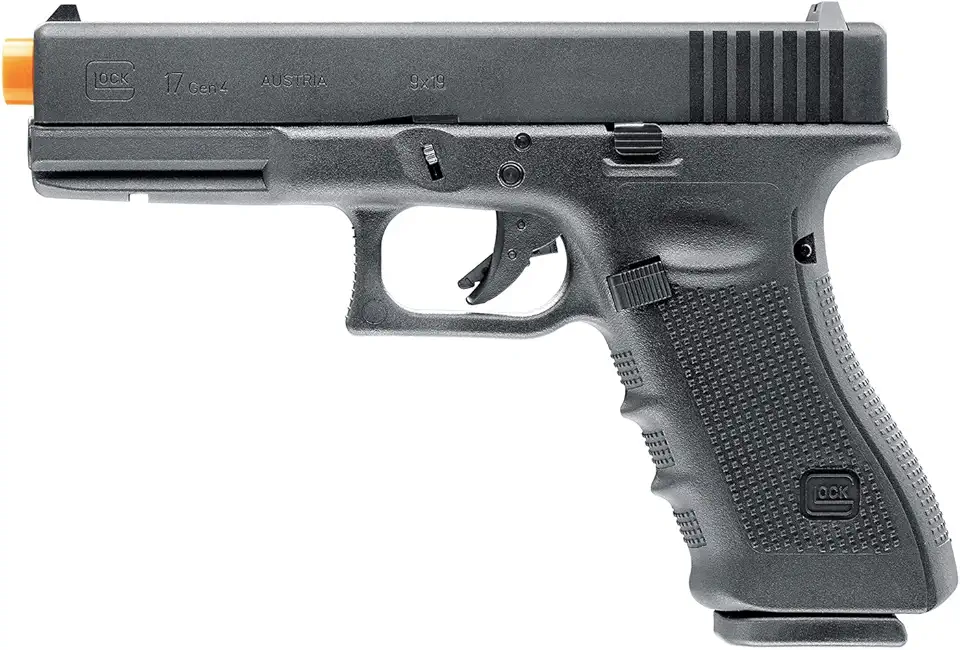
Umarex Glock 17 Gen4 Airsoft Pistol
A licensed full-size gas blowback pistol with modern ergonomics, realistic cycling, and better modular support than many older-style platforms.
The Umarex Glock 17 Gen4 is the better choice if you want modern ergonomics and stronger long-term support. It has a more current platform feel and is often easier to match with holsters and accessories.
The Taurus PT99 still has a place if you prefer classic service pistol styling, a heavier feel, and a more traditional grip shape. The Glock is more practical. The PT99 has more old-school character.
What People Ask Most
Is the Taurus PT99 good for airsoft beginners?
What FPS does the Taurus PT99 shoot?
Is the Taurus PT99 good for CQB?
Does the Taurus PT99 have adjustable hop-up?
How many BBs does the Taurus PT99 magazine hold?
Is the Taurus PT99 better than a Glock airsoft pistol?
Can you mount a light on the Taurus PT99?
Is the Taurus PT99 good for outdoor airsoft?
Conclusion
The Taurus PT99 is a classic full-size gas blowback airsoft pistol for players who care about realistic handling, stable aiming, and traditional service-pistol ergonomics. It is not the newest or most modular platform, but it still offers a satisfying shooting experience.
Its biggest strengths are the metal-slide feel, comfortable grip shape, adjustable hop-up, and planted weight. These qualities make it enjoyable for CQB, target practice, training drills, and backup sidearm use during skirmishes.
The main drawbacks are magazine capacity, full-size bulk, limited aftermarket support, and typical green gas sensitivity in colder weather. If you want maximum customization, a Glock or Hi-Capa platform will probably be a better long-term choice.
But if you want a sidearm with character, realistic weight, and classic Beretta-style handling, the Taurus PT99 still makes sense. It is best for players who value control and realism over pure speed and capacity.
Before buying, check spare magazine availability, confirm holster fit, test your field’s FPS limits, and use quality BBs. Do that, and the PT99 can be a dependable and enjoyable sidearm in the right loadout.
Hogue Grip Panels
A simple grip-focused upgrade for compatible pistol platforms if you want better traction, comfort, and control during long airsoft sessions.