
What Is Joule Creep in Airsoft?
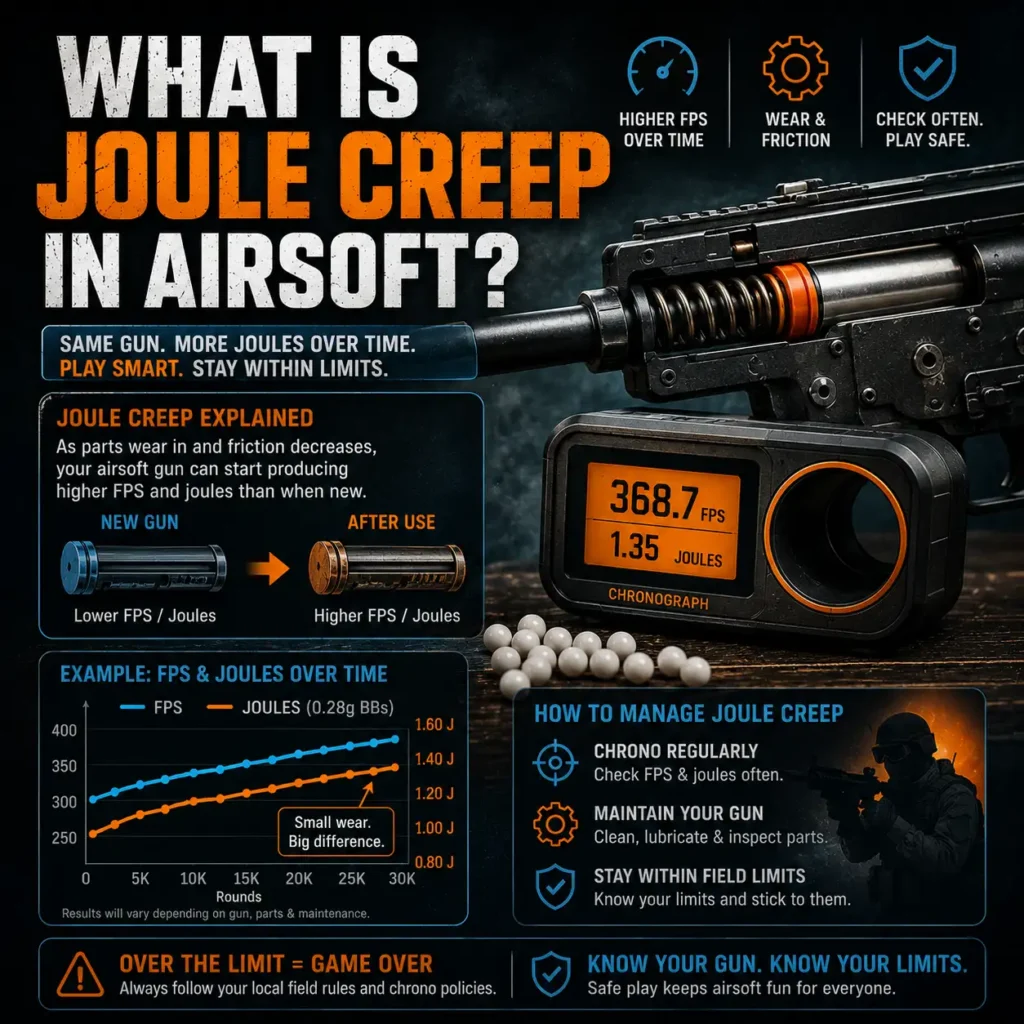
Joule creep is the increase in muzzle energy that can occur when an airsoft gun is fired with heavier BBs, even though the measured FPS may decrease. It is most commonly associated with HPA and some sniper rifle setups, which is why many fields now chrono guns using joule measurements rather than FPS alone.
What Is Joule Creep in Airsoft?
Joule creep describes a situation where an airsoft gun produces more energy when firing heavier BBs than it does with lighter BBs. Because BB weight increases while velocity decreases at a slower rate, the final muzzle energy can rise significantly.
This is why understanding what is joule creep airsoft is important for both players and field operators. A gun that appears field-legal when tested with 0.20g BBs may exceed field energy limits when loaded with heavier ammunition.
Unlike FPS, which only measures velocity, joules measure the actual kinetic energy delivered by the BB. This provides a more accurate representation of the gun’s power.
To better understand the relationship between velocity and energy, see airsoft FPS vs joules.
Understanding FPS, BB Weight and Energy
Many newer players focus entirely on FPS numbers because that is what most chronographs display. However, FPS only tells part of the story.
If two BBs leave the barrel at different velocities but have different masses, they may carry similar or even very different amounts of energy. That is why most modern field regulations are moving toward joule-based limits.
The formula used to calculate muzzle energy is:
Energy (J) = 0.5 × mass (kg) × velocity² (m/s)
Velocity is measured in meters per second. If your chronograph displays FPS, the conversion is:
m/s = FPS × 0.3048
For example:
| BB Weight | Velocity | Energy |
|---|---|---|
| 0.20g | 400 FPS | 1.49 J |
| 0.25g | 358 FPS | 1.49 J |
These examples represent the same energy output. Joule creep occurs when heavier BBs produce more energy instead of maintaining roughly the same energy level.
You can quickly calculate energy values using our FPS to joule calculator.
How Joule Creep Happens
When a BB travels down the barrel, compressed air continues pushing it forward. In some airsoft systems, heavier BBs remain in the barrel slightly longer than lighter BBs, allowing more of the available air volume to transfer energy into the projectile.
As a result, velocity decreases less than expected while BB weight increases. This combination can increase the total muzzle energy.
Consider the following example:
| BB Weight | Velocity | Energy |
|---|---|---|
| 0.20g | 400 FPS | 1.49 J |
| 0.32g | 330 FPS | 1.62 J |
The heavier BB travels slower, yet the rifle delivers more energy. This increase is what players refer to as joule creep.
Does BB Weight Cause Joule Creep?
A common question is does bb weight cause joule creep. The answer is not exactly.
BB weight itself does not create joule creep. Instead, heavier BBs reveal how efficiently a particular airsoft system uses its available air volume.
Some guns maintain nearly identical joule readings across multiple BB weights. Others gain noticeable energy as BB weight increases.
Several factors influence whether a gun exhibits joule creep:
- Barrel length
- Cylinder volume
- Air efficiency
- Nozzle design
- Dwell settings in HPA systems
- BB weight
Choosing the right ammunition is important for performance regardless of joule creep. For a complete overview, see our airsoft BB weight guide.
Why Joule Creep Is Common in HPA Systems
The term joule creep hpa appears frequently because HPA platforms are among the most likely to demonstrate measurable energy increases with heavier BBs.
Unlike many AEGs, HPA systems allow extensive tuning of airflow and dwell settings. When an HPA engine releases a large volume of air, heavier BBs can continue accelerating for a longer period inside the barrel.
This additional acceleration can increase muzzle energy even though FPS decreases.
Not every HPA rifle exhibits severe joule creep. Well-tuned setups may show very little change across different BB weights. However, HPA platforms remain one of the primary reasons many fields now chrono using joules rather than FPS.
Can AEGs and Sniper Rifles Experience Joule Creep?
Yes. Although HPA systems receive most of the attention, AEGs and spring-powered sniper rifles can also exhibit joule creep.
In AEGs, the relationship between cylinder volume and barrel length often determines how much additional energy heavier BBs receive. Some builds remain very consistent, while others show measurable increases.
Sniper rifles may also demonstrate joule creep because they often use heavier BBs and longer barrels. The effect varies greatly depending on the platform and tuning.
This is why chrono testing with the actual ammunition used during gameplay is always recommended.
Why Joule Creep Matters for Field Safety
Field limits exist to balance gameplay and minimize injury risk. If a gun gains energy when heavier BBs are loaded, it may exceed the intended limits despite passing a traditional FPS test.
Imagine a rifle that passes chrono using 0.20g BBs. The same rifle might produce significantly more energy when firing 0.40g BBs during gameplay.
Without joule-based testing, field staff may never detect the difference.
This is particularly important for:
- HPA rifles
- DMRs
- Bolt-action sniper rifles
- High-volume upgraded AEGs
Many sites now publish joule limits instead of FPS limits because joules provide a more accurate measure of actual projectile energy.
How Fields Test for Joule Creep
Chronograph procedures vary between countries and individual sites, but modern airsoft fields often use one or more of the following methods:
- Testing with the BB weight the player intends to use.
- Calculating muzzle energy instead of relying solely on FPS.
- Using joule limits rather than FPS limits.
- Spot-checking HPA and sniper platforms.
- Re-testing after regulator adjustments.
Some sites require players to present their ammunition at registration so chrono testing reflects real game conditions.
This approach makes it much harder for excessively efficient setups to bypass field limits.
How to Check Your Gun for Joule Creep
Testing for joule creep is straightforward if you have access to a chronograph.
- Chronograph your gun using 0.20g BBs.
- Record FPS and calculate joules.
- Repeat with the BB weight you actually use.
- Compare the joule readings.
If energy rises noticeably as BB weight increases, your setup is exhibiting joule creep.
Many players are surprised to discover that their rifle gains energy even though the FPS reading drops significantly.
How to Reduce Joule Creep
Completely eliminating joule creep is not always necessary, but excessive increases can often be reduced through tuning.
- Reduce excessive HPA dwell settings.
- Optimize barrel length.
- Match cylinder volume to barrel length in AEGs.
- Improve air efficiency.
- Chronograph with your actual game BB weight.
- Test after every major upgrade.
Every platform behaves differently, so experimentation and chrono testing are essential.
Joule Creep vs FPS: Which Measurement Matters More?
FPS remains useful because it provides a quick velocity measurement. However, FPS alone cannot reveal the complete performance of an airsoft gun.
Two rifles may produce identical FPS readings with 0.20g BBs while delivering very different amounts of energy with heavier ammunition.
Because of this, joules have become the preferred measurement for many fields and event organizers.
Understanding both velocity and energy is important, but when safety and compliance are concerned, joules provide the more complete picture.
For a deeper explanation of the differences, see airsoft FPS vs joules.