
Airsoft Chrono Guide
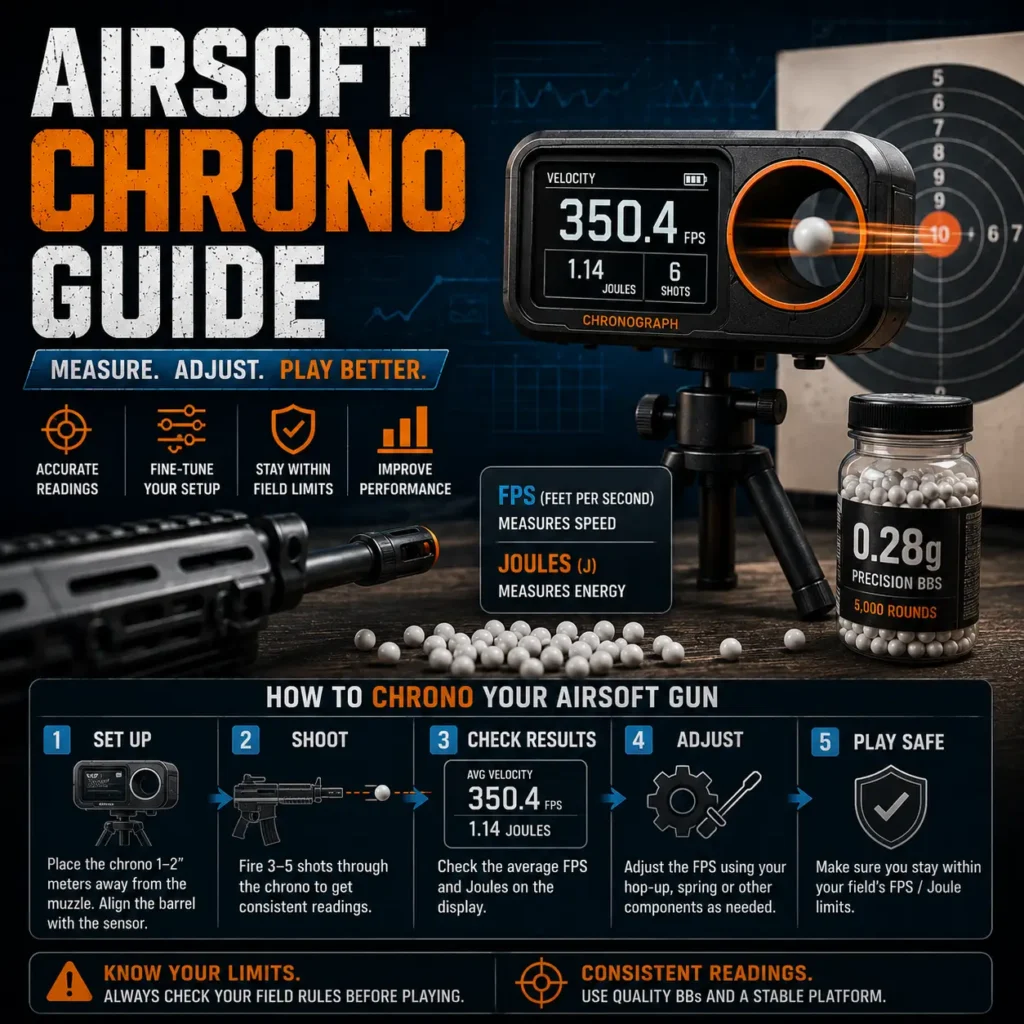
Airsoft chrono testing is the process of measuring your airsoft gun’s velocity and muzzle energy to ensure it complies with field limits and safety rules. Every player should know how to chrono an airsoft gun correctly, especially when using heavier BBs or upgraded platforms.
What Is an Airsoft Chrono?
An airsoft chrono, short for chronograph, is a device that measures how fast a BB travels as it leaves the barrel. Most modern chronographs display velocity in FPS (feet per second), meters per second (m/s), and often calculate joules automatically when BB weight is entered.
Chronograph testing is one of the most important safety procedures in airsoft. It helps fields enforce power limits, ensures fair gameplay, and reduces the risk of injuries caused by overly powerful guns.
Whether you run an AEG, GBBR, HPA rifle, DMR, or bolt-action sniper rifle, regular chrono testing should be part of your maintenance routine.
Why Airsoft Chrono Testing Matters
Many players focus on FPS numbers, but velocity alone does not tell the full story. BB weight, muzzle energy, and platform efficiency all influence actual performance.
Chronograph testing helps determine:
- Whether your gun complies with field limits.
- If upgrades have increased power beyond legal limits.
- Whether your HPA regulator settings are consistent.
- If your rifle exhibits joule creep.
- Whether performance changes over time.
Without chrono testing, it is difficult to know if a gun remains within safe operating limits.
To understand field restrictions in different regions, see airsoft FPS limits by country.
How Does an Airsoft Chronograph Work?
Most airsoft chronographs use optical sensors that detect a BB as it passes through the device.
The chronograph measures the time required for the BB to travel between two sensors and calculates velocity based on that measurement.
Modern units often display:
- FPS (feet per second)
- m/s (meters per second)
- BB weight
- Muzzle energy (joules)
- Shot consistency statistics
Some advanced chronographs can store shot strings and calculate average velocity, minimum velocity, maximum velocity, and standard deviation.
How to Chrono an Airsoft Gun
Many new players ask how to chrono an airsoft gun. The process is simple when performed correctly.
- Ensure the chronograph is powered on.
- Select the correct BB weight if your chronograph requires it.
- Load your magazine with the BBs you intend to use.
- Position the barrel directly in front of the chrono opening.
- Fire several shots through the device.
- Record FPS and joule readings.
- Calculate averages rather than relying on a single shot.
Most fields require multiple shots because occasional velocity spikes can occur.
For the most accurate results:
- Keep the barrel centered.
- Avoid shooting at an angle.
- Use quality BBs.
- Test with the hop-up adjusted as you normally play.
- Fire several shots before recording data.
What BB Weight Should You Chrono With?
One of the most common questions is what bb weight to chrono with.
The answer depends on field rules.
Historically, many fields chronoed every gun using 0.20g BBs. However, this approach can miss issues such as joule creep, particularly on HPA and sniper platforms.
Today, many fields require players to chrono using the exact BB weight they intend to use during gameplay.
Common examples include:
| Platform | Typical BB Weight |
|---|---|
| Rental AEG | 0.20g – 0.25g |
| Standard AEG | 0.25g – 0.28g |
| DMR | 0.32g – 0.40g |
| Sniper Rifle | 0.40g – 0.50g+ |
Using your actual game ammunition provides the most accurate measurement of real-world muzzle energy.
For help selecting ammunition, see our airsoft BB weight guide.
FPS vs Joules During Chrono Testing
Many players mistakenly believe FPS is the only number that matters.
In reality, joules provide a more complete measurement because they account for both velocity and BB weight.
Muzzle energy is calculated using:
Energy (J) = 0.5 × mass (kg) × velocity² (m/s)
This means two guns showing identical FPS readings may produce different energy outputs when using different BB weights.
That is why more fields now use joule limits rather than FPS-only limits.
You can calculate energy instantly using our FPS to joule calculator.
Common Airsoft Chrono Rules
Different fields use different procedures, but several airsoft chrono rules are widely adopted.
- Every gun must pass chrono before entering the field.
- HPA systems may require regulator locks.
- Players must use the same BB weight during gameplay that was used during chrono testing.
- DMRs and sniper rifles may have minimum engagement distances.
- Random chrono checks may occur throughout the day.
- Chrono failures usually require adjustment before play.
Some fields also test magazines separately to prevent players from swapping to higher-powered setups after inspection.
How Many Shots Should You Fire Through a Chronograph?
A single shot rarely tells the full story.
Most experienced players and field staff prefer testing multiple shots to identify consistency.
A good practice is to fire at least:
- 3 shots for a quick check.
- 5 shots for a typical field chrono.
- 10 shots when evaluating consistency.
Recording averages helps eliminate occasional fluctuations caused by gas pressure changes, magazine temperature, or feeding inconsistencies.
Common Chronograph Mistakes
Several mistakes can produce inaccurate readings.
- Using the wrong BB weight setting.
- Shooting through the chrono at an angle.
- Using poor-quality BBs.
- Testing with an empty or nearly empty gas magazine.
- Changing regulator settings after chrono.
- Recording only a single shot.
These errors can make a gun appear weaker or stronger than it actually is.
How Often Should You Chrono Your Airsoft Gun?
Most casual players chrono their guns at the field before games. However, more frequent testing can help identify issues before they become problems.
It is a good idea to chrono:
- After installing upgrades.
- After changing springs.
- After adjusting HPA regulators.
- When switching BB weights.
- Before major events.
- If performance suddenly changes.
Regular testing ensures your setup remains safe, consistent, and field legal.