
Airsoft FPS Limits by Country
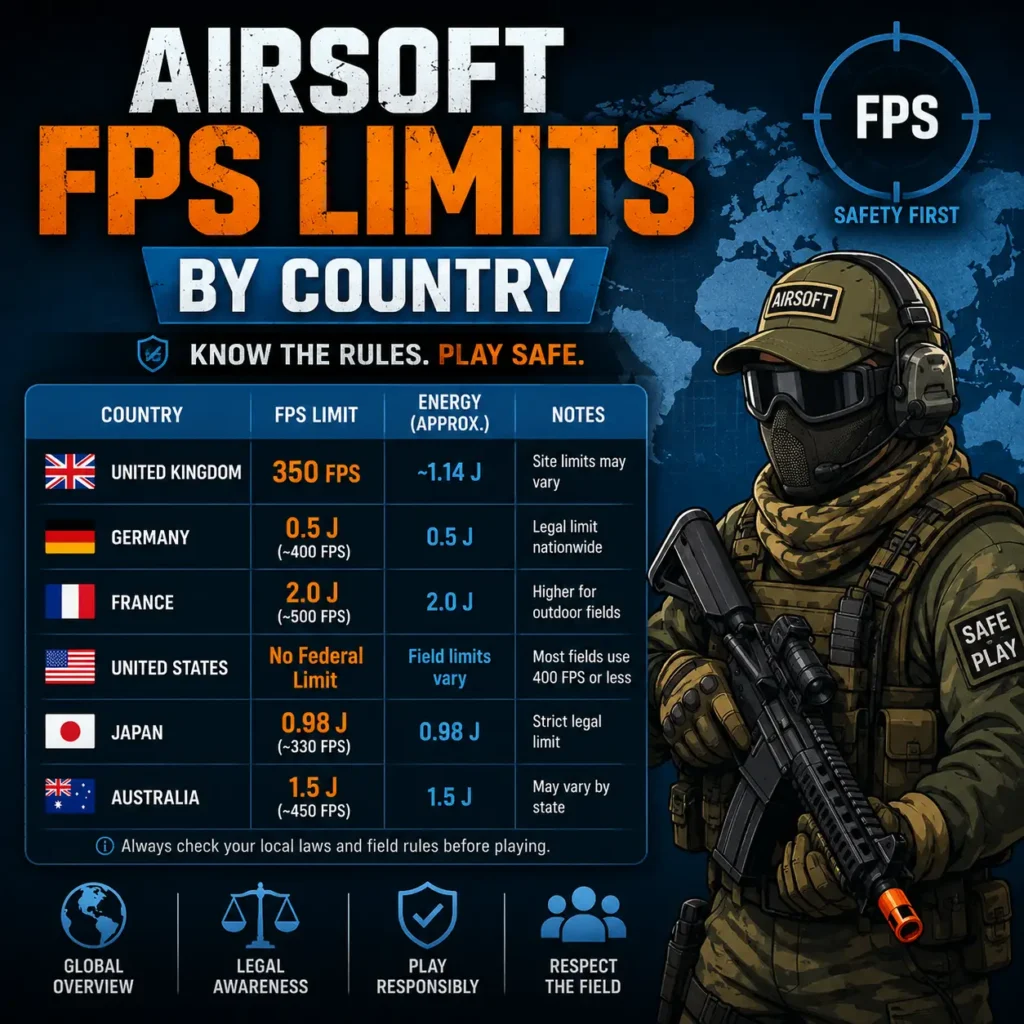
Airsoft FPS limits vary significantly between countries, airsoft fields, and game types. While some sites regulate guns using FPS measurements, many modern fields now enforce joule limits because they provide a more accurate measure of actual muzzle energy.
Why Airsoft FPS Limits Exist
Airsoft FPS limits are designed to keep gameplay safe while maintaining a fair balance between different weapon types. A close-range CQB rifle should not have the same power allowance as a bolt-action sniper rifle engaging targets at long distances.
Without power limits, players could use highly upgraded guns that increase the risk of injury and create an unfair playing environment.
Most fields enforce limits during chrono testing before players are allowed onto the field. Depending on the site, limits may be measured using FPS, joules, or both.
If you are unfamiliar with chrono procedures, see our airsoft chrono guide.
FPS vs Joules: Why FPS Is Not the Whole Story
Many players assume FPS is the only number that matters, but FPS only measures velocity. It does not account for BB weight.
Two rifles can produce identical FPS readings while delivering different amounts of energy when using different BB weights.
This is why many fields now use airsoft joule limits instead of velocity-only limits.
Muzzle energy is calculated using:
Energy (J) = 0.5 × mass (kg) × velocity² (m/s)
Because joules account for both mass and velocity, they provide a more accurate representation of actual power.
For a complete explanation, see airsoft FPS vs joules.
You can also calculate energy using our FPS to joule calculator.
Typical Airsoft FPS Limits by Field Type
Although every field creates its own rules, certain limits are commonly used throughout the airsoft community.
| Weapon Type | Typical FPS Limit (0.20g) | Typical Energy Limit |
|---|---|---|
| CQB Rifle | 300-350 FPS | 0.84-1.14 J |
| Standard AEG | 350-400 FPS | 1.14-1.49 J |
| DMR | 400-450 FPS | 1.49-1.88 J |
| Bolt-Action Sniper | 450-500 FPS | 1.88-2.32 J |
These figures represent common ranges rather than universal standards. Always verify local field rules before attending an event.
CQB FPS Limit Rules
The CQB FPS limit is generally lower than outdoor limits because engagement distances are much shorter.
Indoor arenas often involve encounters at distances of only a few meters. Lower power limits help reduce the risk of injury while maintaining fast-paced gameplay.
Many CQB sites operate between:
- 300 FPS (0.84 J)
- 330 FPS (1.01 J)
- 350 FPS (1.14 J)
Some facilities may require semi-automatic fire only and prohibit high-powered DMR or sniper platforms entirely.
Because CQB limits vary widely, checking field regulations beforehand is essential.
Airsoft FPS Limit by Country
One of the most common questions players ask is about the airsoft FPS limit by country. The challenge is that many countries do not have a single nationwide field limit.
In many cases, national laws establish legal ownership limits, while individual fields determine gameplay limits.
The table below summarizes general legal thresholds or commonly encountered limits. Local laws and field regulations may differ.
| Country | General Reference Limit | Notes |
|---|---|---|
| United Kingdom | 1.13 J automatic / 2.5 J bolt-action | Based on legal thresholds commonly referenced under UK legislation. |
| Germany | 0.5 J full-auto limit | Higher-energy guns are typically restricted to semi-auto. |
| France | Generally around 2 J legal ownership threshold | Field limits often lower. |
| Poland | Field-dependent | Most sites use joule-based limits. |
| United States | Field-dependent | No nationwide airsoft FPS limit. |
| Canada | Field-dependent | Rules vary between provinces and fields. |
| Japan | Approximately 0.98 J | Strict national power regulations. |
Because laws change and local interpretations vary, players should always consult current regulations and field-specific rules before traveling with airsoft equipment.
DMR Limits and Minimum Engagement Distances
Designated Marksman Rifles (DMRs) typically operate at higher power levels than standard rifles.
To balance this increased power, many fields require:
- Semi-automatic fire only.
- A minimum engagement distance (MED).
- Specific joule limits.
- Locked firing modes.
Common DMR limits fall between 1.5 J and 1.9 J, although some fields allow slightly higher values.
The exact requirements vary considerably between regions.
Sniper Rifle Limits
Bolt-action sniper rifles usually receive the highest power allowance because they operate at lower rates of fire and engage targets at longer distances.
Many fields permit sniper rifles in the range of:
- 2.0 J
- 2.3 J
- 2.5 J
- 3.0 J (less common)
Higher power limits almost always come with larger minimum engagement distances.
Some fields require sidearms when engaging targets inside the sniper rifle’s minimum distance.
How Joule Creep Can Affect FPS Limits
A rifle may pass an FPS test but still exceed field energy limits because of joule creep.
Joule creep occurs when heavier BBs produce more muzzle energy than expected. This is particularly common in certain HPA setups and some sniper platforms.
As a result, many fields now chrono players using the BB weight they actually intend to use during gameplay.
This approach provides a more accurate measurement of real-world performance and safety.
Why More Fields Are Switching to Joule Limits
The airsoft industry has gradually shifted toward joule-based regulations because they eliminate many of the inconsistencies associated with FPS-only measurements.
Benefits of joule limits include:
- More accurate power measurement.
- Better detection of joule creep.
- Improved player safety.
- Consistent standards across different BB weights.
- Fairer regulation of HPA and sniper platforms.
Many experienced players now consider joules the most meaningful way to evaluate field compliance.
How to Check Whether Your Gun Is Field Legal
Before attending a game, you should:
- Check the field’s published power limits.
- Determine whether limits are measured in FPS or joules.
- Chronograph your gun using your actual game BB weight.
- Verify regulator settings if using HPA.
- Calculate muzzle energy if necessary.
Taking a few minutes to test your setup can prevent disappointment at registration and ensure compliance with field safety standards.