
Gas vs Electric (AEG): Which Airsoft Gun Wins?
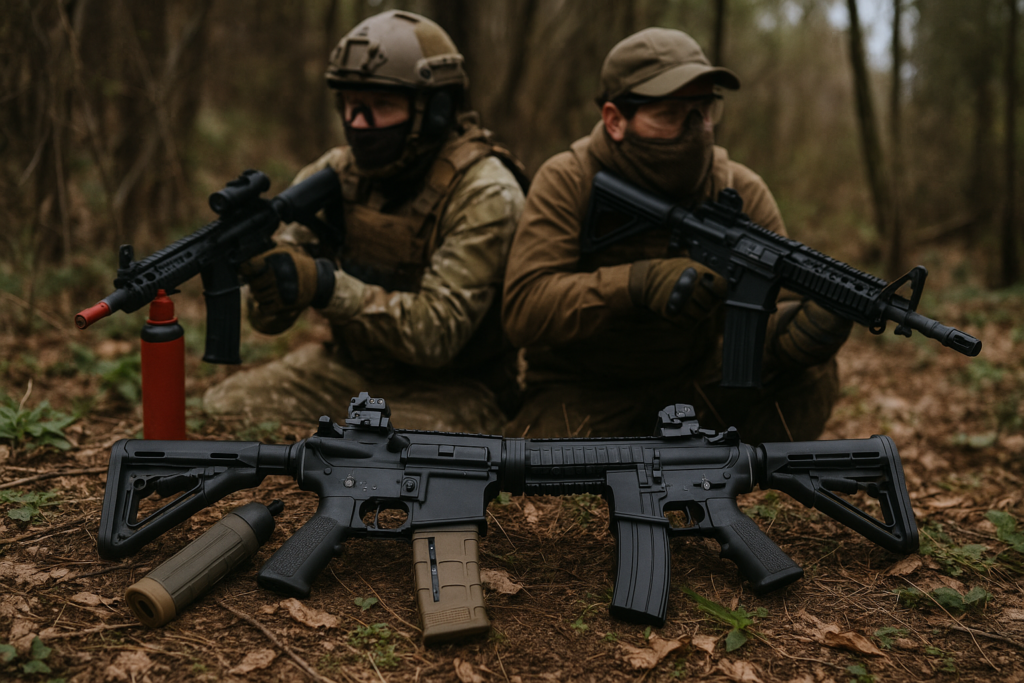
Gas vs Electric (AEG) is one of the most important choices in airsoft because it affects reliability, running costs, feel, and how much work your setup needs between game days. The short version: if you want the easiest, most consistent all-round option, choose an AEG; if you value recoil, realism, and a more mechanical shooting experience, gas can be more satisfying but usually asks more from the player.
| Factor | Gas | Electric (AEG) |
|---|---|---|
| Ease of use | More involved; depends on gas, seals, magazines, and temperature | Easier for most players; charge battery, load mags, play |
| Weather consistency | Can struggle in cold conditions | Usually more stable across temperatures |
| Realism and recoil | Stronger mechanical feel, especially with blowback platforms | Less recoil and realism, but more practical for many players |
| Rate of fire and sustained fire | Typically less forgiving for long strings of shots | Usually better for sustained semi and full-auto use |
| Running costs | Requires gas and often more magazine investment | Requires batteries and charger; often cheaper per game |
| Maintenance | More routine care for seals, valves, and magazines | Less day-to-day upkeep, though internal repairs can be technical |
| Best for beginners | Usually not the easiest starting point for a primary | Best overall starting choice for most players |
| Best use case | Training feel, realism, pistols, enthusiast setups | General skirmishing, rentals, entry-level to advanced play |
What is Gas?
In airsoft, gas-powered guns use compressed gas stored either in the magazine or in a separate reservoir, depending on the platform. Common gas types include green gas and CO2, and the system uses that stored pressure to cycle the action and launch the BB.
When players say “gas,” they often mean gas blowback guns. These are especially common for pistols and are also popular in rifles for players who want a more realistic manual of arms. Gas systems can offer a satisfying recoil impulse, functional bolt movement, and magazine handling that feels closer to real firearms than most AEGs do.
That realism is the main attraction, but it comes with tradeoffs. Gas performance depends heavily on temperature, gas pressure, magazine condition, and how quickly you fire. In warm conditions and with well-maintained magazines, gas can feel excellent. In cold weather or during rapid strings of shots, consistency often drops faster than it does with an AEG.
What is Electric (AEG)?
AEG stands for Automatic Electric Gun. It uses a battery-powered motor to pull back a spring inside a gearbox, then release it to fire the BB. This system has been the standard skirmish platform for years because it is practical, adaptable, and widely supported.
AEGs cover almost every common rifle role in airsoft, from starter carbines to advanced upgraded builds. They are popular because they are simple to run: charge a battery, bring loaded magazines, and you are usually ready for a full day. They also tend to be less affected by ambient temperature than gas platforms.
Another major advantage is ecosystem support. AEG magazines, internal parts, batteries, chargers, and repair knowledge are broadly available. If you are comparing your first serious primary, the answer for most players is still an AEG because it is easier to learn, easier to keep running, and easier to use in different game formats.
Gas vs Electric (AEG): Head-to-Head
Performance and consistency
If your priority is repeatable performance shot after shot, AEGs usually have the edge. Their power source does not rely on gas pressure changing inside a magazine as you fire. That matters in actual play because consistency affects not only velocity, but also how predictable the gun feels over the course of a match.
Gas guns can perform very well, but they are more sensitive to variables. Magazine temperature, gas type, firing pace, and seal condition all influence output. A gas rifle may feel excellent at the start of a game and then behave differently after repeated rapid shots or after sitting in the cold. A gas pistol can still be a great sidearm, but for a main field gun, that variation is an important practical consideration.
For site limits, remember that FPS alone does not tell the whole story. If you need to understand energy limits better, an airsoft FPS to joule calculator can help you compare setups more accurately.
Cold weather and temperature sensitivity
This is one of the clearest differences in the gas vs electric airsoft debate. Gas systems are much more temperature-sensitive. In colder conditions, pressure drops, cycling can become sluggish, and guns may fail to lock back, feed consistently, or maintain stable output. Rapid firing can also cool the magazine further, reducing performance even more.
AEGs are not immune to weather, but they are generally less affected by ambient temperature in normal skirmish conditions. Battery efficiency can change in the cold, yet an AEG usually remains more dependable than a gas platform when temperatures fall.
If you play outdoors through multiple seasons, especially in cooler regions, an AEG is almost always the safer recommendation. If you mainly play in warm climates or indoors, gas becomes easier to justify as a primary.
Realism, recoil, and shooting feel
This is where gas often wins. A gas blowback rifle or pistol gives you moving parts, a sharper impulse, and a more involved manual of arms. Reloads often feel more meaningful because magazines are heavier and operating controls behave more like their real counterparts. For players who value immersion, that mechanical character matters a lot.
AEGs can be very effective, but the feel is more synthetic. Trigger response can be crisp on a well-built setup, but the overall shooting sensation is usually smoother and less dramatic. There is less recoil and less of that physical feedback many realism-focused players want.
So the question here is simple: do you want the gun to feel alive, or do you want it to be as practical as possible? Gas appeals strongly to enthusiasts who prioritize experience. AEGs appeal to players who prioritize results and simplicity.
Cost to buy and cost per game
Initial cost varies widely in both categories, but the spending pattern is different. With gas, the platform itself may only be part of the budget. Magazines are often a major expense, especially for gas rifles, because you usually want several and they are heavier, more complex, and often pricier than standard AEG magazines. You also need a regular supply of gas or CO2.
With an AEG, you normally budget for the gun, battery, charger, and magazines. After that, the cost per game is often easier to manage because rechargeable batteries spread the expense over many sessions. If you are estimating battery needs for game day, an AEG battery runtime calculator is useful.
For many players, AEGs are cheaper to live with over time. Gas is not automatically unaffordable, but it tends to involve more recurring cost and more expensive spare magazines for a comparable field loadout.
Maintenance and reliability
Gas guns generally demand more routine attention. Magazines contain valves and seals, and those parts need care if you want reliable performance. Leaks, worn seals, inconsistent fill habits, and dirt around valves can all create problems. None of this is impossible to manage, but it does require a player who is willing to learn the platform.
AEGs usually ask for less frequent day-to-day maintenance. Keep the barrel clean, battery healthy, and magazines functional, and they often deliver dependable service. When an AEG does break internally, repairs can be technical because the gearbox is a compact mechanical system. Still, for many owners, that repair event happens less often than the smaller routine issues gas users deal with.
Put another way: gas maintenance is often lighter but more frequent; AEG maintenance is often less frequent but can be more specialized when something major goes wrong.
Magazine management and field practicality
Magazine handling changes the whole game-day experience. Gas magazines tend to be heavier and bulkier because they store the propellant as well as the BBs. That added weight can feel great for realism, but carrying several magazines is more tiring and more expensive. You also need to think about keeping them warm enough in cold weather and making sure they are properly filled.
AEG magazines are more practical for most skirmishers. They are generally lighter, easier to transport, and available in many capacities. That makes it simpler to tailor your loadout to site rules, whether you use low-cap, mid-cap, or high-cap magazines.
If you play long objective games, support your team with sustained fire, or simply want fewer variables during a match, AEG magazine logistics are hard to beat.
Upgrades, parts, and availability
AEGs usually win on parts support. The market for AEG internals, externals, magazines, batteries, motors, gears, hop-up parts, and accessories is massive. That means more choice, more repair knowledge, and more flexibility if you want to tune the gun for a specific role.
Gas platforms can also be upgraded, but support varies more by brand and platform. Some systems have strong aftermarket ecosystems; others are much less forgiving. Parts compatibility can be less universal than it is in the AEG world, and local tech support may be harder to find.
If you want the broadest path for future changes, AEG is usually the safer platform. If you already know you want a specific gas rifle or pistol ecosystem and are comfortable with its quirks, gas can still be rewarding.
Beginner-friendliness
For a first primary, AEG is the standard recommendation for good reason. It is easier to operate, easier to keep field-ready, and easier to troubleshoot. New players already have enough to learn: eye protection, site rules, safe handling, battery care, and basic maintenance. An AEG reduces the number of extra variables.
Gas can still make sense for a first sidearm, since gas pistols are common and many players enjoy them. But as a main skirmish platform, starting with gas often means taking on more complexity before you have learned what kind of player you are.
If you want a broad view of useful tools for setup decisions, check out these airsoft calculators and tools.
Which Should You Choose?
The right answer depends less on which system is “better” and more on how you play, where you play, and what kind of ownership experience you actually want.
Choose Gas if …
- You care a lot about recoil, realism, and mechanical feedback.
- You enjoy the idea of learning magazine care, seals, valves, and gas behavior.
- You mostly play in warm or stable temperatures.
- You want a pistol sidearm, where gas is a very common and sensible choice.
- You value immersion over maximum convenience.
- You are comfortable paying more attention to magazines and recurring consumables.
Gas is a strong choice for players who treat airsoft as more than just a way to send BBs downrange. If the handling experience, bolt movement, and realistic reloads are part of the fun for you, gas can be deeply satisfying. It is especially attractive for enthusiasts, training-focused users, and players who do not mind tuning their setup around environmental conditions.
Choose Electric (AEG) if …
- You want one platform that works well in the widest range of situations.
- You are buying your first primary airsoft gun.
- You play in mixed or cold weather.
- You want lower hassle on game day.
- You need easier access to magazines, replacement parts, and upgrade options.
- You prefer consistent performance over realism and recoil.
For most players, especially beginners and regular skirmishers, an AEG is the more practical answer. It is easier to recommend because it handles the broadest set of airsoft needs with the fewest compromises. If your goal is to show up, play effectively, and spend less time managing the platform itself, AEG is usually the best fit.
A simple way to decide is this: if your priority is dependable field performance, buy an AEG first. If your priority is experience and realism, and you accept the extra cost and maintenance, gas may be the platform you enjoy more in the long run.